Rigid vs Stretch Denim: What Brands Should Specify
Rigid and stretch denim differ in yarn construction and measured behavior—not just fiber percentages. Compare stretch direction, growth, recovery, fit and wash approval before sampling jeans.
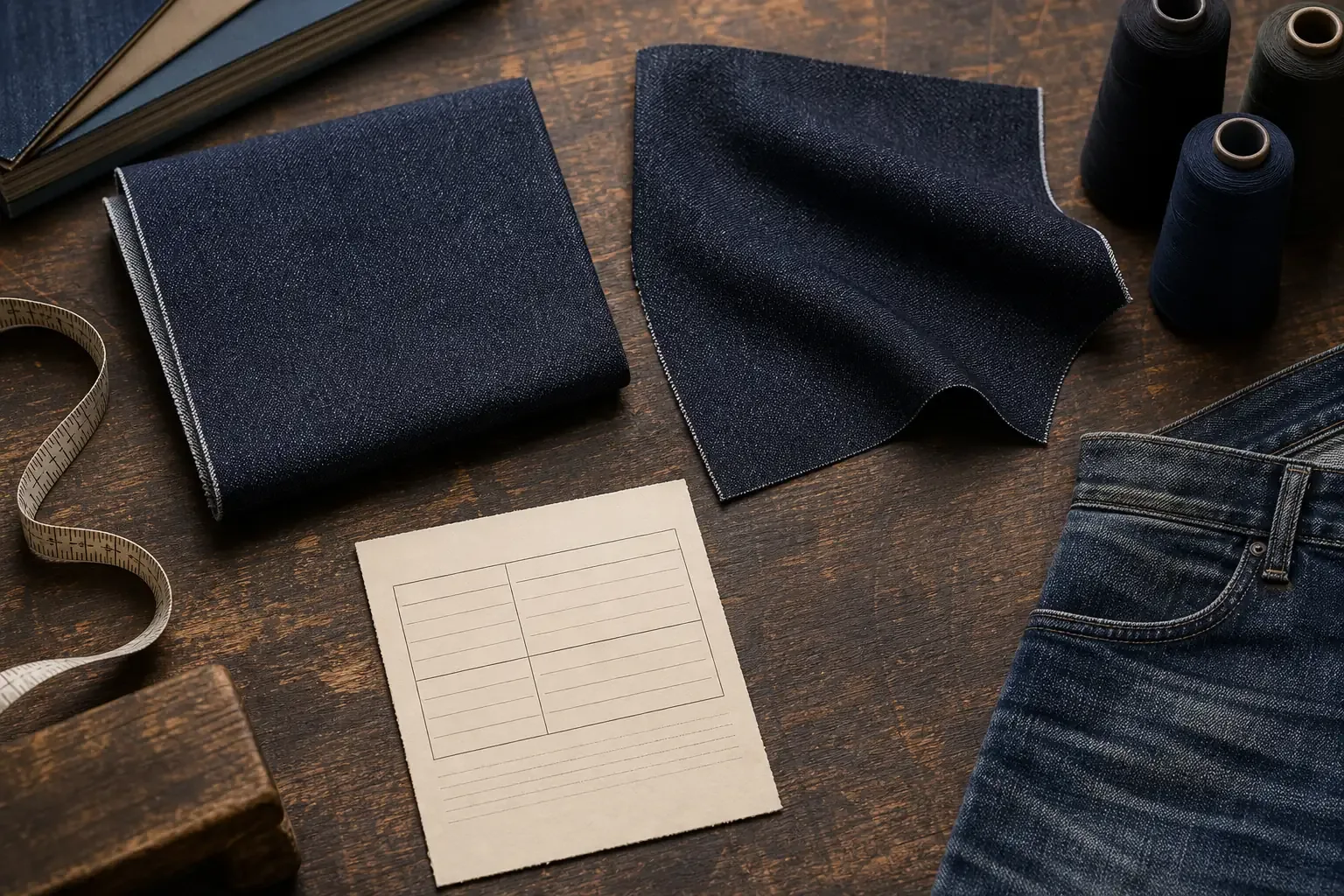
In this guide, rigid denim means denim with no added elastic fiber, while stretch denim uses an elastic yarn or another engineered stretch component. That distinction is useful, but it is not enough to develop a pair of jeans. Fiber percentage does not tell a pattern maker how far the cloth extends, which direction stretches, how much it grows under wear or how well it recovers.
For a brand, the practical comparison is therefore composition plus measured behavior plus finished-garment approval. Record the denim identity, stretch direction, test method, growth and recovery, then approve fit after the intended wash or finish. “Rigid” and “stretch” are starting labels, not complete specifications.
What Is the Difference Between Rigid and Stretch Denim?
In this guide, rigid denim means a woven denim without an added elastomer. It is often 100% cotton, but the fiber declaration still needs to be checked rather than inferred from the word “rigid.” Stretch denim includes yarns designed to extend and recover. A common construction puts a spandex core inside a cotton-covered filling yarn; CottonWorks documents this as one route to filling-direction stretch.
The words raw, washed and selvedge answer different questions. Raw describes a finishing state, while selvedge describes an edge and weaving context. Neither word proves that the fabric is rigid, and “rigid” does not specify weight, wash or loom type. Those decisions remain separate.
| Decision | Rigid denim starting point | Stretch denim starting point | What the brand must confirm |
|---|---|---|---|
| Yarn system | No added elastomer | Elastic or engineered stretch yarn in one or more directions | Fiber declaration and yarn/construction description |
| Movement | Mobility comes mainly from pattern ease and fabric geometry | Fabric extension can contribute to mobility and close fit | Stretch by direction under an agreed method |
| Shape after load | Cotton and structure can still relax or grow during wear | Extension may be higher, but recovery is not automatic | Growth and recovery after a stated load, extension and recovery time |
| Silhouette | Can support a crisp or stand-away line when the exact cloth has enough body | Can support close or flexible fits when the exact cloth recovers suitably | Finished weight, hand, drape and approved fit sample |
| Wash response | Finish can change dimensions, hand and shade | Finish can also affect the stretch system and recovery | Results after the intended garment finish and care route |
This table is a development map, not a rule that one family is always stronger, more comfortable or more durable. Yarn, weave, density, weight, finishing and garment construction can change the outcome inside either family.
Why Does Fiber Content Not Tell You How Stretchy Denim Is?
Fiber content is an identity statement. For products covered by the U.S. Textile Fiber Rule, the Federal Trade Commission requires generic fiber names and percentages by weight; its guidance uses “96% Cotton, 4% Spandex” as an example of a functionally significant fiber below five percent. That label tells a buyer what fibers are present. It does not state the fabric's extension, growth or recovery.
Several structural variables sit between the label and the garment:
- which yarn system contains the stretch component;
- whether the elastic component is core-spun, dual-core or another construction;
- warp and filling density, yarn count and twist;
- the amount of extension introduced while weaving and finishing;
- finished weight, width and mechanical finish;
- the wash or care condition in which performance is measured.
A peer-reviewed comparison of cotton-covered elastic core and dual-core denim yarns found that changing the core system changed multiple fabric properties, including elastic behavior, dimensional change, stiffness and strength. The study also reported that fabric construction could influence post-wash width variation more than elastane ratio in the fabrics examined. The sourcing lesson is narrow but important: do not convert elastane percentage directly into a promised stretch percentage.
Visible pale elastic yarn under extension is also not a stretch-percentage result. Use the spandex grin and elastane-breakage evidence guide to separate exposure, demonstrated yarn damage and recovery loss before assigning a cause.
What Do Stretch, Growth and Recovery Mean?
These terms describe different stages of one load-and-release event:
- Stretch describes extension while the specified force or extension is applied.
- Growth describes residual enlargement after that stress is removed.
- Recovery describes movement back toward the original dimension over an identified interval.
A fabric can extend easily and still grow too much at the knee or seat. Another can have lower extension but recover consistently. “Comfort stretch,” “power stretch,” “two-way” and “four-way” are useful commercial shorthand only when the supplier connects them to direction and test data.
ASTM D3107-26 covers stretch, growth and recovery for applicable woven fabrics made wholly or partly with stretch yarns. ASTM also warns that the method is not recommended as a stand-alone acceptance test for commercial shipments because between-laboratory precision is known to be poor. ISO 20932-1:2018 provides strip and loop methods for elasticity and related properties and was confirmed as current in 2024.
That caveat belongs in the specification. Name the selected method, specimen direction, applied procedure, recovery interval and acceptance rule. When results from different laboratories matter, agree how comparative testing or bias will be handled instead of treating two unqualified percentages as interchangeable.
How Does Stretch Direction Change Pattern and Fit?
Denim is woven from warp and filling yarn systems. A filling-stretch construction can add movement across the garment without supplying the same extension along its length. A fabric engineered to move in both directions creates a different pattern problem. The brand should therefore record warp and filling behavior separately, not rely on “four-way stretch” as the only line in a tech pack.
Pattern ease then connects that behavior to the body. A rigid block normally carries movement through garment dimensions, shaping and construction. A stretch block may use the material's extension as part of the fit. There is no universal negative-ease value: intended silhouette, body range, rise, pocket construction, waistband, wash and measured recovery all matter.
The denim fits and cuts guide owns the silhouette taxonomy, while the denim weight guide owns ounces, GSM and body. For this decision, use both as inputs and approve the exact cloth against the exact block. Do not move one pattern between rigid and stretch denim without a new fit review.
| Intended direction | Useful material starting point | Sample question |
|---|---|---|
| Crisp straight, loose or stand-away volume | A rigid or low-extension denim with enough measured body may suit the line | Does the garment move comfortably at the agreed waist, seat and thigh measurements? |
| Close fit with mobility | A measured stretch denim may allow a closer block | Does it recover at the waistband, seat and knee after movement? |
| Washed fashion jean | Either family can work | Do fit, shade, hand and recovery still match after the approved finish? |
| Mixed rigid and elastic components | Treat the assembly as a system | Do waistband, pocketing, thread and denim change together without distortion? |
These are sample questions, not promises that every rigid or stretch construction behaves the same way.
How Should Wash and Care Be Included in the Approval?
Washing and finishing can change dimensions, surface, hand and elastic behavior. The 2021 denim study cited above evaluated performance after finishing because the core material and process interact. A separate open-access study in Scientific Reports also describes elastane as sensitive to wet and heat treatments in the stretch-denim systems it examined. Neither paper supplies a universal factory recipe; both support testing the selected fabric after its intended route.
Approve at three clearly named states:
- Fabric state: identify the tested swatch or cutting taken from the roll and record whether its data is greige, finished or already washed.
- Garment-development state: check assembly and movement, while noting which finishing steps are still pending.
- Final approval state: measure and fit the sample after the approved garment wash or finish, using the agreed points of measure.
The denim washes guide owns stone, enzyme, acid and appearance-led wash selection. The cotton shrinkage guide owns laundering methods and dimensional-change tolerances. This page's job is to make sure the stretch decision is not separated from those owners.
What Should a Brand Put in a Denim Specification?
Use a line-by-line fabric record instead of “premium stretch denim”:
- Fabric ID and revision: supplier or mill code, color, lot reference and approval date
- Fiber declaration: generic fiber names and percentages
- Construction: denim weave direction and yarn/stretch construction, where known
- Finished physical state: finished weight, usable width, hand and surface reference
- Stretch direction: warp, filling or both
- Measured behavior: method, stretch, growth, recovery interval and acceptance rule
- Finish and care state: the wash or finish used before the values were recorded
- Garment connection: pattern revision, sample size, POM chart and target silhouette
- Physical standards: approved fabric swatch and approved finished-garment sample
Keep unknowns visible as TBD rather than filling them with generic percentages. A supplier can then propose material against the intended garment, and the brand can compare submissions on the same basis.
Three catalogue references show why a finished look still needs its own material brief: stone-washed baggy heavyweight denim pants, washed straight-leg jeans with spider-web stitching, and light-wash wide-leg jeans with side embroidery. Their pages are visual product directions; they do not prove the fiber composition or stretch specification for a new order.
How Do You Approve Rigid or Stretch Denim Before Bulk?
Start with a physical swatch and a written behavior record. Develop the pattern on that approved direction, then evaluate movement and points of measure on the sample. If the jeans will be garment washed, repeat the fit and measurement review after the intended finish. Before bulk cutting, compare production fabric with the same identity and behavior references rather than accepting a similar color alone.
The how jeans are made guide maps that end-to-end handoff. Jiashun sources finished denim and manufactures garments; it does not claim to spin, dye yarn or weave denim. The applicable mill, finishing and testing route is confirmed for the project.
For a custom review, send the fit reference, pattern or tech pack, sample size and POM chart, wash direction, fabric hand and movement target, order quantity by color and size, and any fixed composition requirement. Jiashun's custom denim program can then review the fabric, fit, finish, trims and decoration as one garment system.
Frequently Asked Questions About Rigid vs Stretch Denim
Is rigid denim always 100% cotton?
It is often 100% cotton, but “rigid” should not replace the fiber declaration. In this guide it means no added elastomer. A fabric can include another non-elastic fiber and still be marketed as non-stretch, so verify generic fiber names and percentages.
Does 1% or 2% spandex tell you how stretchy denim is?
No. Fiber percentage identifies composition, not extension, growth or recovery. Yarn construction, density, direction, finishing and the selected test procedure also affect the result. Ask for measured warp and filling behavior under an agreed method.
Is rigid or stretch denim better for baggy jeans?
Neither is automatically better. A baggy silhouette often needs enough body to hold its line, but comfort, drape, wash and recovery still depend on the exact fabric and pattern. Approve the selected material on a finished fit sample rather than choosing by family name alone.
Does rigid denim stretch during wear?
It can relax or grow as yarns and the woven structure respond to movement, even without an elastic fiber. That is not the same as engineered elastic recovery. If shape retention matters, record growth and the garment measurements at a stated condition.
Should jeans fit be approved before or after washing?
Construction can be reviewed before washing, but final fit should be approved after the intended garment finish when a wash is part of the program. Wet and mechanical processing can change dimensions, hand and how seams settle.
References
- Federal Trade Commission, “Textile Fiber Rule” and “Calling It Cotton” — U.S. fiber-content disclosure requirements and the functionally significant spandex example.
- CottonWorks by Cotton Incorporated, “Denim Construction” — denim yarn systems and cotton-covered spandex core yarn used for filling stretch.
- ASTM International, ASTM D3107-26 — stretch, growth and recovery of applicable woven fabrics made with stretch yarns, including the method's acceptance-testing caveat.
- International Organization for Standardization, ISO 20932-1:2018 — strip and loop methods for elasticity and related properties; confirmed current in 2024.
- Babaarslan, Shahid and Doğan, “Comparative analysis of cotton covered elastomeric hybrid yarns and denim fabric properties”, Journal of Engineered Fibers and Fabrics (2021) — experimental comparison of core and dual-core yarn and fabric properties.
- El-Gabry et al., “Dyeing of advanced denim fabrics … using different processes”, Scientific Reports (2024) — open-access study of elastic denim systems and wet/heat processing sensitivity.
Related guides
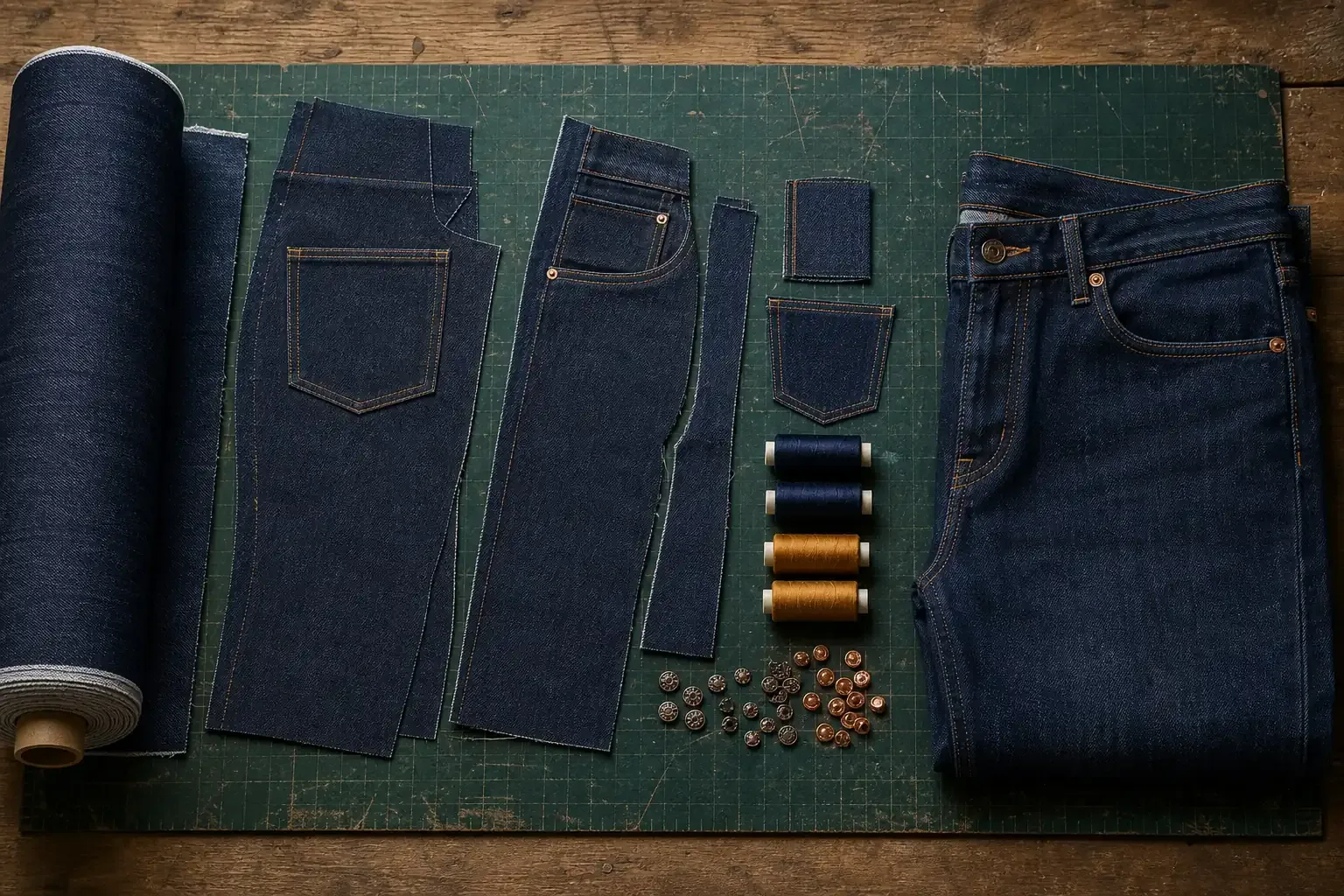 How Are Jeans Made? From Denim to Final Inspection
 Denim Weight Explained: Oz, GSM and Choosing the Right Cloth for Your Jeans
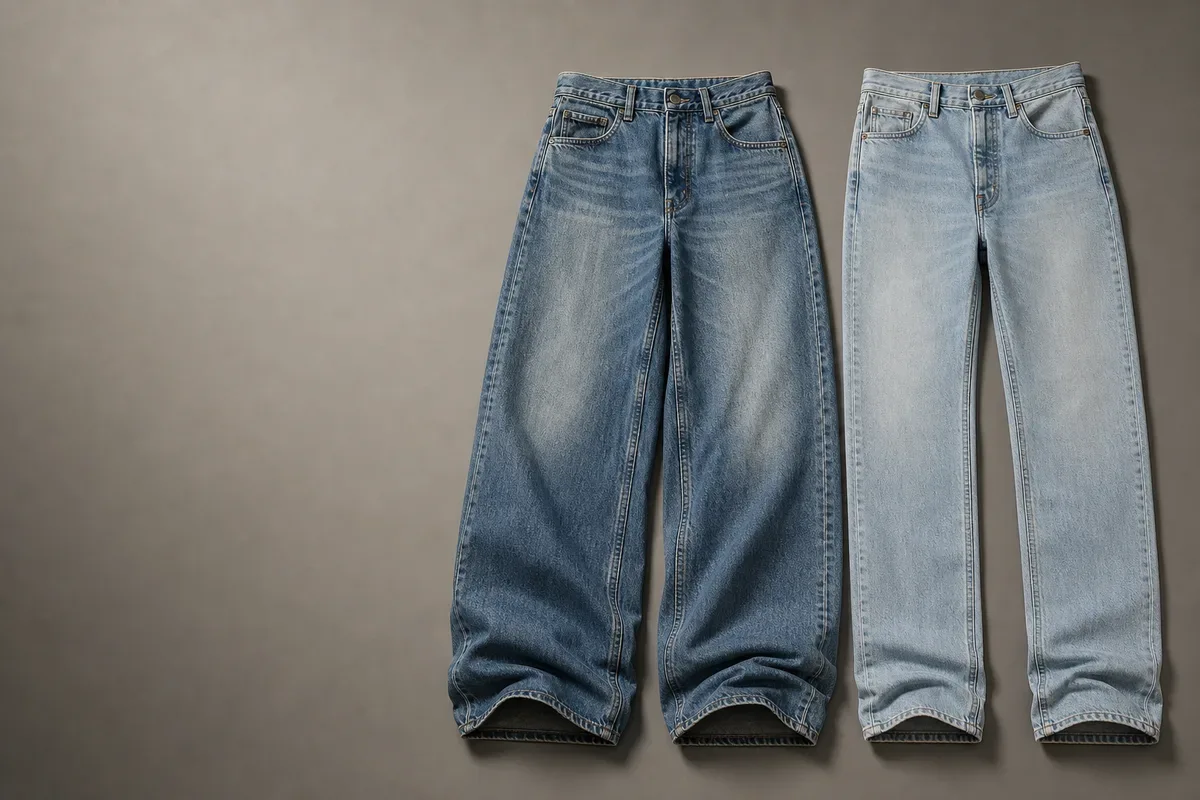 Denim Fits for Streetwear: What to Spec Before the First Sample
 Denim Washes Explained: Stone, Enzyme, Acid and Sun-Fade — and How to Approve Them
 How Much Does Cotton Shrink? The Science, the Standards, and the Tolerance to Put in Your Tech Pack