Fabric Abrasion vs Tear Strength: Which Evidence Does a Brand Need?
Abrasion and tear tests reproduce different failure modes. Learn how garment zones, method, endpoint, direction and specimen state determine which evidence a clothing brand can compare.
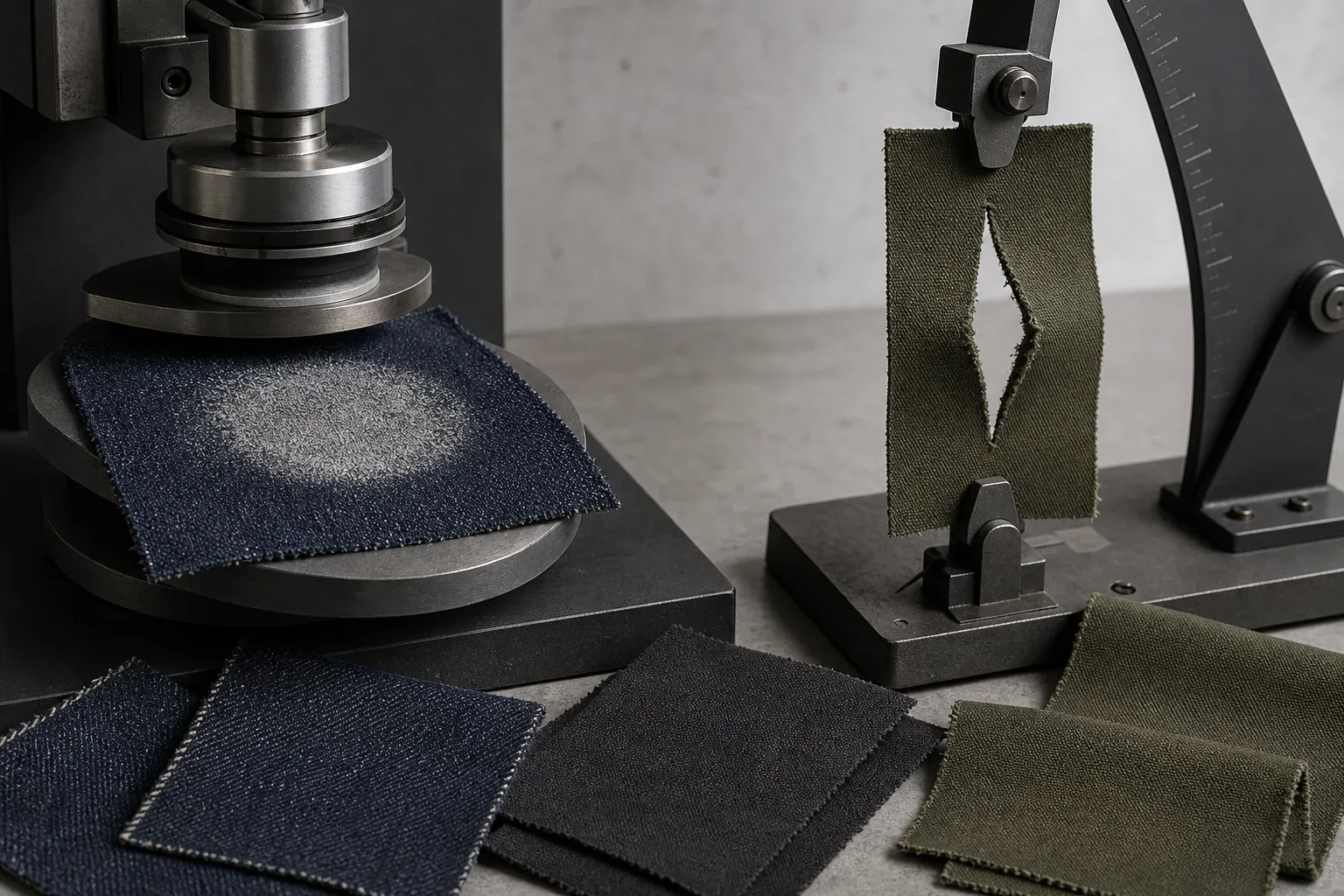
Fabric abrasion resistance describes how a specimen responds to controlled surface rubbing, while tear strength describes the force involved in propagating a tear that has already been initiated. A clothing brand needs the property that matches the plausible failure at the garment zone—not whichever report has the larger number. Results are comparable only when the method, endpoint or calculation, specimen direction, material state and reporting units align.
Abrasion cycles do not show whether an existing cut will grow, and tear force does not predict surface wear. Neither result proves garment life, seam security, colorfastness, puncture resistance or lot acceptance.
Abrasion and Tear Begin With Different Events
Abrasion begins at a surface. A named apparatus moves an abradant against a prepared specimen under controlled conditions, and the selected procedure defines what is evaluated. Depending on the method and project, the endpoint may concern specimen breakdown or another stated surface-related change. The number is meaningful only beside that setup and endpoint.
Tear testing begins after an opening has been deliberately introduced into the test specimen. The method then measures resistance as that tear propagates. This matters because the force required to start a cut, snag or puncture is not the same question as the force recorded after the method has created its starting geometry.
| Property | Controlled event and useful output | Interpretation boundary |
|---|---|---|
| Surface abrasion | Repeated contact with a stated abradant, apparatus and setup; response at the named endpoint | Does not prove years of wear, tear propagation, puncture or seam strength |
| Tear strength | Propagation from a method-defined, initiated tear; force under the named geometry, apparatus and direction | Does not prove resistance to starting a cut, surface wear or whole-garment durability |
Tear strength is also not tensile or breaking strength. ASTM D5034-21(2025) covers grab procedures for breaking strength and elongation; a tear method starts with a cut. ASTM D2261's use of a tensile testing machine does not turn its tongue-tear result into breaking strength. Keep the property, geometry and calculation with the number.
ASTM D4966-22(2026) covers abrasion resistance using a Martindale abrasion tester. ASTM D3884-22 is a guide for the rotary platform abrader. Those are not interchangeable labels for one universal abrasion scale. ISO 12947-2:2016 is narrower still: it addresses specimen breakdown under the Martindale family and excludes coated and laminated fabrics from that part's scope.
For tear, ASTM D1424-25 uses a falling-pendulum apparatus and covers the force needed to propagate a single-rip tear starting from a cut. ASTM D2261-13(2024) uses a tongue, or single-rip, specimen with a tensile testing machine. ISO 13937-2:2000, confirmed current in 2023, uses trouser-shaped specimens for a single-tear method. A result from one route should not be relabeled as though it came from another.
Start With the Garment Zone, Not a Generic “Durability” Request
The right evidence question begins with what contacts the garment, where the first visible change is likely to appear and how that change could progress.
| Garment zone or observation | First evidence question | Route the adjacent issue elsewhere |
|---|---|---|
| Knee, elbow, seat or outer pocket face repeatedly rubs against a surface | How does the identified material respond under the agreed abrasion setup and endpoint? | Shade transfer belongs to colorfastness testing |
| Pocket corner, cargo flap or cut edge could continue opening after damage starts | How does an initiated tear propagate in the relevant material direction? | Reinforcement and seam failure need assembly evidence |
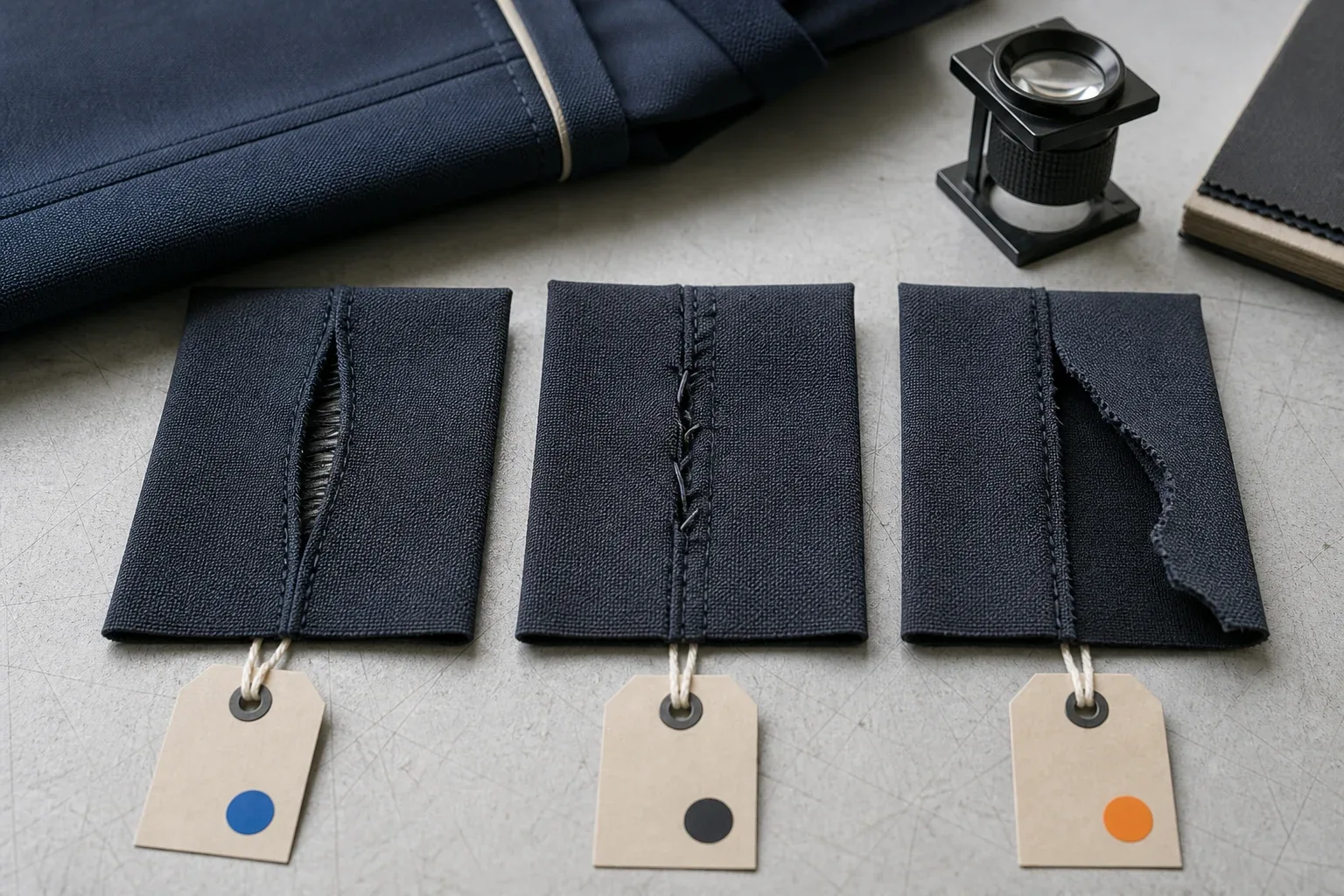
| Gap or distortion grows beside intact stitching | Did yarns slip at the seam, did thread rupture or did body fabric tear? | Use the seam-failure diagnosis |
| Garment changes length or width after laundering | What dimensional change occurred under the agreed wash and dry route? | Use the shrinkage and tolerance owner |
| Buyer wants to accept or reject a finished-goods lot | What sampling plan, defect rules and disposition authority apply? | Use the garment AQL guide |
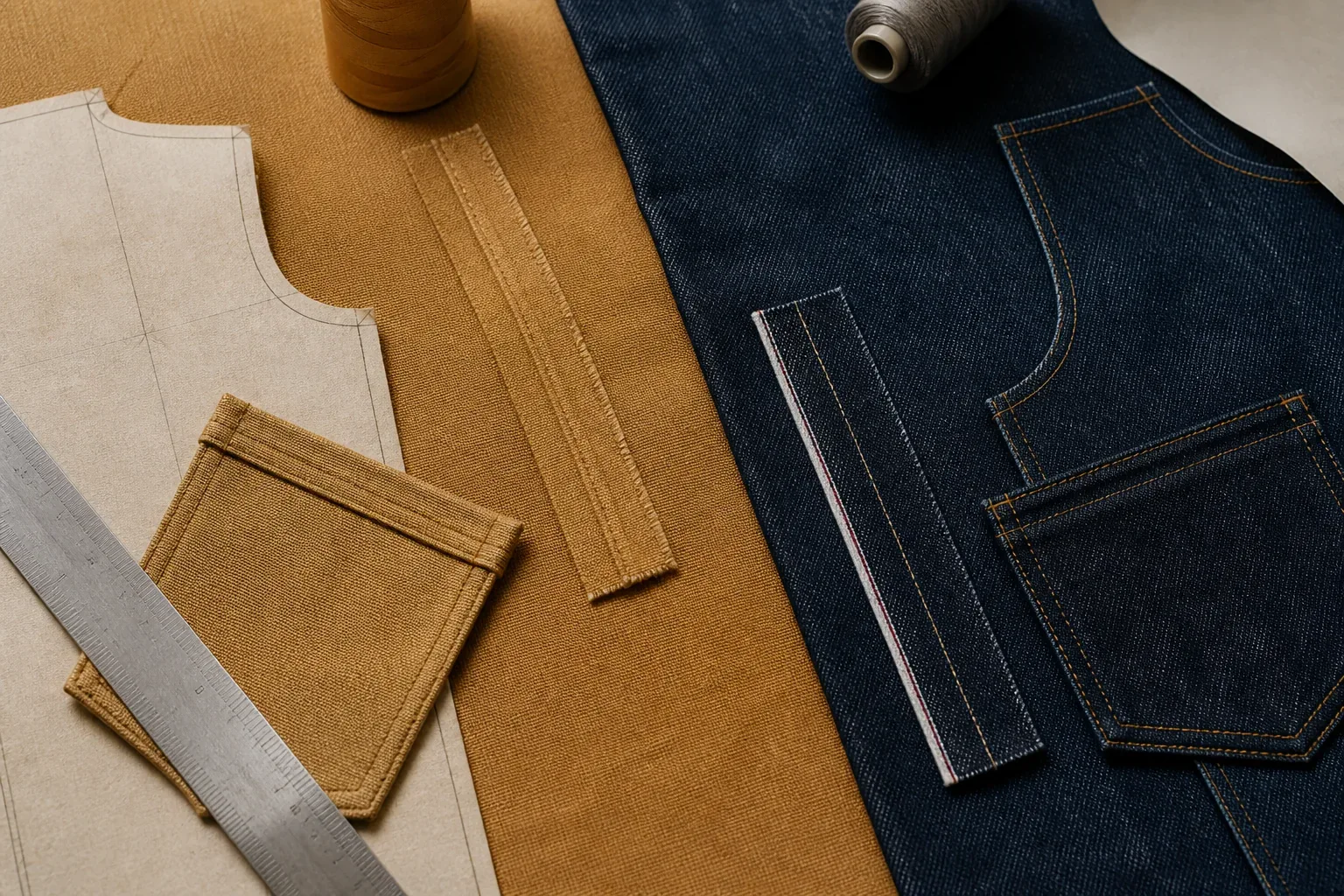
Three product pages make the zone logic visible. A canvas work jacket with zipper pockets has cuffs, elbows, pocket edges and layered closure areas. A baggy washed denim pant has knees, a seat, pocket corners and seam intersections. A heavyweight oversized boxy T-shirt presents a knit body, hems and decorated surface.
These links are visual design context only. They do not prove a hidden composition, fabric weight, finish, test method, test result or performance grade, and they do not establish what another order requires.
For a workwear program deciding between those two material families, the duck canvas versus denim guide turns the zone-level questions into a paired sample plan without declaring a universal durability winner.
Why an Abrasion Cycle Count Is Not Wear Life
Abrasion is unusually sensitive to the test system. ASTM D3884 identifies influences including fiber and yarn properties, fabric construction, finish, abradant, specimen tension, pressure, dimensional change and evaluation. ASTM D4966 likewise notes variation from the abradant, apparatus conditions, operator and evaluation, including poor agreement that can occur within and between laboratories.
The public significance statement for ASTM D4966 says that the method is not considered satisfactory for acceptance testing of commercial fabric shipments because between-laboratory precision is poor. The parties therefore need a common method, controlled specimens and a stated interpretation before treating two results as equivalent.
Most importantly, both ASTM abrasion pages caution against turning laboratory abrasion into actual wear life without evidence connecting the test to the intended end use. A result of a stated number of cycles means that the specimen reached—or did not reach—the stated endpoint under that test. It does not mean the garment will last that many wears, days or washes.
Ask four property-specific questions before comparing abrasion data:
- Which apparatus and exact method edition produced the result?
- Which abradant, loading or pressure condition and endpoint were stated?
- Was the specimen an unfinished fabric, finished fabric, washed material or another defined state?
- Are both candidates evaluated under the same setup and interpretation?
A Martindale specimen-breakdown result and a rotary-platform result should not share one ranking table merely because both mention abrasion. ISO 12947-2 also directs coated-surface abrasion elsewhere.
Tear Strength Measures Propagation After a Defined Start
Tear reports also require the exact route. ASTM D1424 creates a single-rip tear from a cut and uses a falling pendulum. ASTM D2261 uses a tongue specimen in a tensile tester and states that its reported result is not directly related to the force needed to initiate a tear. The two apparatuses, specimen geometries and calculations are different evidence systems.
ASTM D2261 also explains why broad minimums are unsafe: tear force is irregular, its reported values are empirical, and the comparison is meaningful for similar fabrics tested and measured in the same way. It states that no known procedure works for all fabrics to determine one minimum tearing strength. The standard can support an agreed project comparison; it does not supply a universal apparel grade.
Direction must travel with the result. Woven materials can respond differently according to specimen orientation and the yarn system involved; other constructions and treatments can raise separate applicability questions. Record the laboratory's direction terminology and specimen diagram instead of translating a lone “warp” or “weft” label from memory.
An initiated-tear result still leaves important garment questions open. It does not reveal whether a sharp object will first puncture the cloth. It does not show whether a needle line damaged yarns during sewing. It does not decide whether a pocket corner needs a geometry or reinforcement change. The test belongs inside a failure-mode review, not in place of one.
Five Fields Decide Whether Two Results Are Comparable
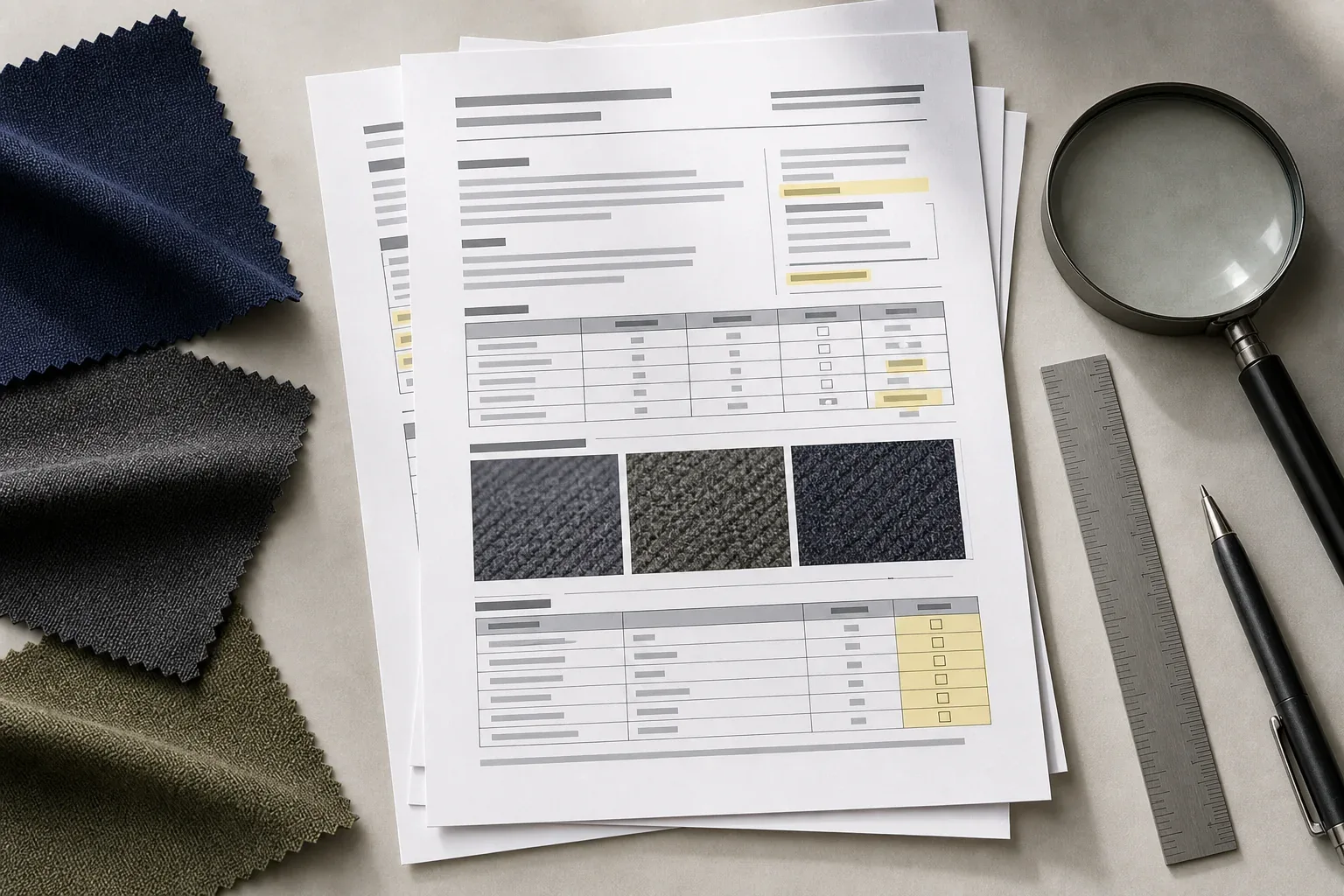
This page does not replace general report literacy. The textile test report guide covers document identity, scope, deviations and the difference between a report and certification. For abrasion-versus-tear decisions, use this narrower comparison gate:
| Comparison field | Comparable evidence | Stop and clarify |
|---|---|---|
| Method and edition | Same named procedure and applicable version | “Martindale,” “tear test” or a standard family without the exact part |
| Endpoint or calculation | Same breakdown definition, evaluation or tear-force calculation | One value records specimen breakdown while another records a different change |
| Specimen identity and state | Controlled fabric, lot or sample identity in the same relevant finished or treated state | Greige, finished, coated, washed or garment specimens mixed without explanation |
| Direction and preparation | Same applicable orientation, specimen geometry and conditioning route | Direction missing, reversed or described with incompatible terminology |
| Units and reported result | Same unit basis and like-for-like result field | Converted, averaged or selected values without the original basis |
ASTM D1776/D1776M-20(2024) covers textile conditioning when the selected method requires it, including moisture-equilibrium considerations. Record the invoked route rather than adding one generic preparation to every request.
Build Evidence From a Controlled Product Question
A useful workflow stays project-specific:
- Name the observed or plausible failure. Describe surface wear, an initiated tear, a seam opening or another signal without collapsing them into “weak fabric.”
- Map it to a garment zone. Record the component, face, direction, layer stack, finish and relevant contact or load.
- Identify the material state. Preserve supplier quality, lot or sample-lot, color, finish, wash state and specimen source.
- Agree the evidence question. Ask the relevant test provider which current method and specimen route fit the material and end-use question.
- Set the project criterion before seeing the result. The responsible buyer and technical parties should define the comparison or acceptance rule; the method name does not choose it for them.
- Compare under matched conditions. Keep method, endpoint, direction, preparation, units and reporting logic aligned.
- Return to the garment. Review the production-intent sample at the mapped zone after the intended finish or care route.
- Record scope and reopen triggers. A material, finish, color, construction or end-use change can make earlier evidence non-representative.
Testing one specimen does not establish conformity for every roll or finished unit. Commercial-lot sampling and disposition must be defined separately. A laboratory result also cannot certify a factory or prove performance outside its stated scope.
What Jiashun Can Discuss During Fabric Development
Jiashun can review the garment reference, material direction, finish, decoration, garment zone and buyer-supplied test requirement during a custom cut-and-sew project. The target is an identified fabric and production-intent sample whose evidence matches the product question.
Jiashun does not claim an in-house textile laboratory or one fixed abrasion-and-tear procedure. Special testing, testing party, specimen plan, criterion and third-party evidence are project-specific. Send the garment reference, zone, expected exposure, fabric identity and any existing report or brand manual for technical review.
Claims to Avoid
- Do not say a heavier fabric is automatically more abrasion resistant or harder to tear.
- Do not compare values from different abrasion apparatuses, endpoints or material states as one leaderboard.
- Do not compare falling-pendulum, tongue and trouser-tear results as interchangeable numbers.
- Do not turn cycles into wears, years or guaranteed product life.
- Do not use one fabric result to prove seam strength, puncture resistance, colorfastness or lot acceptance.
- Do not publish a universal grade or minimum without an applicable product requirement and agreed authority.
- Do not describe ordinary fashion garments as PPE or claim certification from a material test.
- Do not infer test performance from a product photograph or fabric family name.
Frequently Asked Questions
Is abrasion resistance the same as tear strength?
No. Abrasion testing evaluates a specimen's response to controlled surface rubbing under a named setup and endpoint. Tear testing evaluates propagation after the method has initiated a tear. A fabric can perform differently on the two properties because they reproduce different events.
Does a higher Martindale cycle result mean a garment will last longer?
Not automatically. The result belongs to the stated method, abradant, loading condition, endpoint and specimen state. ASTM cautions that laboratory abrasion should not be converted into actual wear life without evidence linking the test to the intended end use.
Which fabric tear test should a clothing brand request?
There is no single best method for every fabric and question. Falling-pendulum, tongue and trouser-shaped routes use different apparatuses and specimen geometries. Agree the applicable method with the test provider, then keep direction, state, units and calculation consistent across candidates.
Can fabric weight predict abrasion or tear strength?
No. Weight may be one descriptive field, but fiber, yarn, construction, density, finish, direction, specimen state and test setup can all affect the result. Compare identified materials rather than treating grams per square metre or ounces per square yard as a strength grade.
Does a passing abrasion or tear result approve the finished-garment lot?
Not by itself. A property result covers the reported specimen and scope. Garment construction, finishing and the mapped end-use zone still require review, while lot sampling, defect rules and acceptance authority belong in the order's inspection plan.
References
- ASTM International, ASTM D4966-22(2026), Standard Test Method for Abrasion Resistance of Textile Fabrics (Martindale Abrasion Tester Method) — public scope, variability, acceptance-testing and wear-life limitations; retrieved 2026-08-09.
- ASTM International, ASTM D3884-22, Standard Guide for Abrasion Resistance of Textile Fabrics (Rotary Platform Abrader Method) — abrasion variables, method scope and end-use correlation limits; retrieved 2026-08-09.
- ASTM International, ASTM D1424-25, Standard Test Method for Tearing Strength of Fabrics by Falling-Pendulum (Elmendorf-Type) Apparatus — single-rip propagation from a cut and apparatus scope; retrieved 2026-08-09.
- ASTM International, ASTM D2261-13(2024), Standard Test Method for Tearing Strength of Fabrics by the Tongue (Single Rip) Procedure — initiated-tear limitation, comparative-use boundary and method scope; retrieved 2026-08-09.
- ASTM International, ASTM D1776/D1776M-20(2024), Standard Practice for Conditioning and Testing Textiles — conditioning and moisture-equilibrium scope when invoked by a test method; retrieved 2026-08-09.
- ASTM International, ASTM D5034-21(2025), Standard Test Method for Breaking Strength and Elongation of Textile Fabrics (Grab Test) — breaking-strength and elongation scope used to distinguish tensile evidence from initiated-tear evidence; retrieved 2026-08-09.
- International Organization for Standardization, ISO 12947-2:2016, Textiles — Determination of the abrasion resistance of fabrics by the Martindale method — Part 2: Determination of specimen breakdown — specimen-breakdown scope, applicability and coated-fabric exclusion; retrieved 2026-08-09.
- International Organization for Standardization, ISO 13937-2:2000, Textiles — Tear properties of fabrics — Part 2: Determination of tear force of trouser-shaped test specimens (Single tear method) — official title, published status and 2023 confirmation; retrieved 2026-08-09.