Yarn-Dyed vs Piece-Dyed Fabric: What Changes Before Garment Production
Yarn-dyed and piece-dyed describe when color enters textile production. Compare design effects, approval evidence, sourcing decisions and claims to avoid.
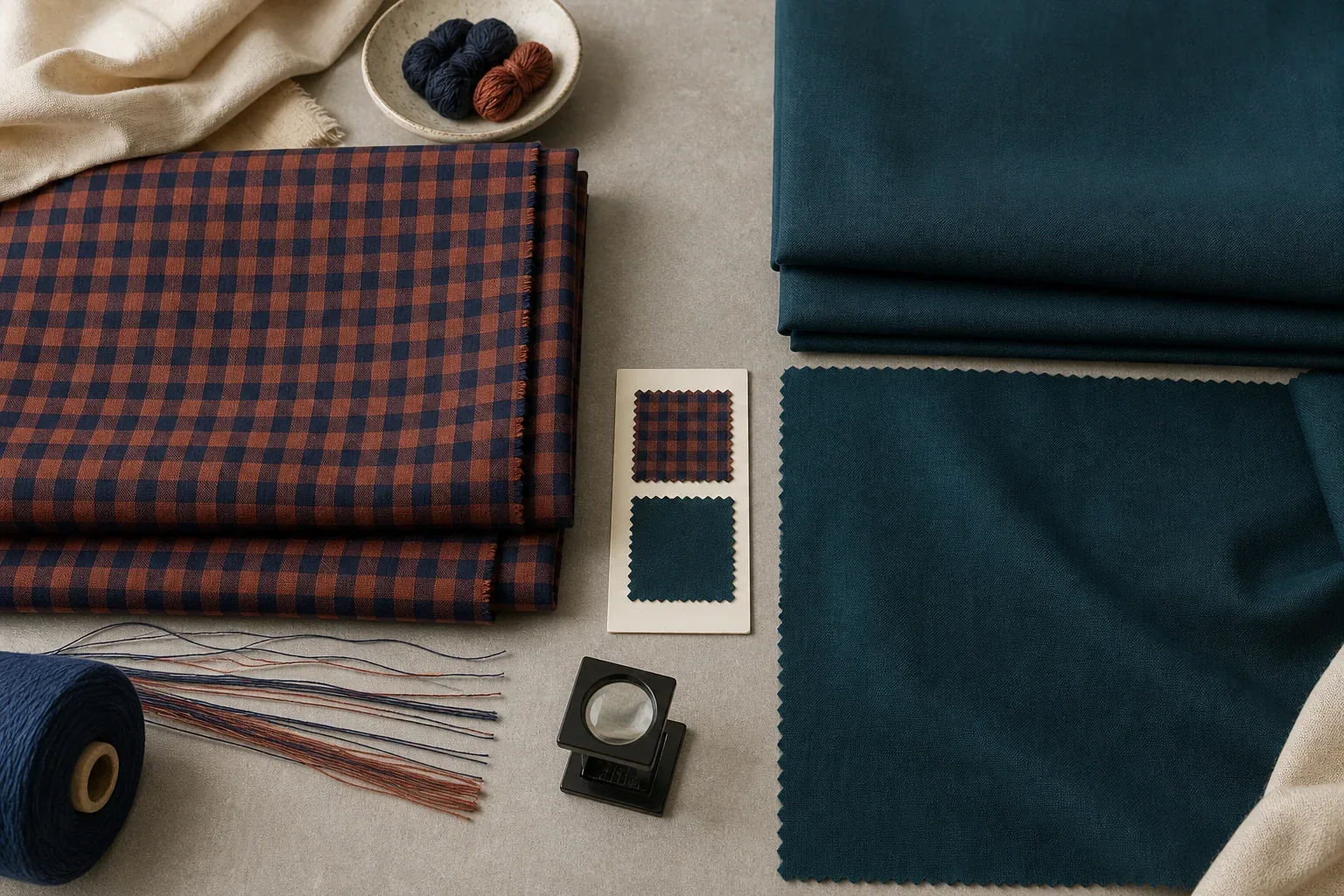
Yarn-dyed fabric is made from yarns colored before the fabric is woven or knitted. Piece-dyed fabric is colored after the fabric has already been formed. That sequence changes which design decisions must be fixed first and which physical evidence a buyer should approve.
It does not create two universal quality grades. Yarn-dyed is not automatically more durable, premium or colorfast. Piece-dyed is not automatically cheaper, faster or limited to basic cloth. Fiber, yarn, construction, dye class, preparation, machinery, finish, lot size and end-use requirements still shape the result.
The practical choice is therefore not “which process is better?” It is “which route can reproduce the intended color effect on the named fabric, and what must be approved before that material enters garment production?”
Yarn-Dyed vs Piece-Dyed at a Glance
| Decision | Yarn-dyed route | Piece-dyed route |
|---|---|---|
| When color is applied | Before weaving or knitting | After the fabric is woven or knitted |
| Common design use | Colors arranged within the fabric construction, including many stripes, checks and plaids | A color applied across an already formed fabric, commonly for solid-color programs |
| Early decisions | Yarn colors, their arrangement, construction and any woven or knitted repeat | Greige or prepared fabric identity, dye color, preparation, dye process and finish |
| Useful development evidence | Identified dyed-yarn references plus a constructed fabric sample when arrangement matters | Identified substrate plus a dye submission or supplier swatch appropriate to the route |
| What the route does not prove | Colorfastness, bulk-lot consistency, garment suitability, price or delivery | Colorfastness, bulk-lot consistency, garment suitability, price or delivery |
The descriptions in the table are common production patterns, not exclusive categories. A solid fabric can be made from yarns of one dyed color. A patterned appearance can be printed rather than built from differently colored yarns. Some blends can also be colored selectively after fabric formation. Name the actual process instead of inferring it from one photograph.
What Does Yarn-Dyed Fabric Mean?
In this comparison, yarn-dyed means the yarn receives color before it becomes fabric. Cotton Incorporated's yarn-dyeing definition describes package dyeing, in which yarn wound on perforated tubes is colored by dye liquor flowing through the package. Its broader textile-dyeing technical booklet also describes skein, package, beam and space-dyeing routes.
The method matters to the textile producer, but a garment buyer does not need to prescribe equipment without a technical reason. The buyer does need to identify the intended result and obtain a process record from the relevant mill or supplier.
Yarn dyeing is often selected when color placement belongs inside the construction. In a woven plaid, differently colored warp and filling yarns cross according to a planned arrangement. In a stripe, color sequence and repeat become part of the fabric design. Knitted structures can also arrange colored yarns into stripes or other effects, but their machine setup and construction language differ from weaving.
That means color and construction cannot be treated as separate late-stage choices. Changing one yarn shade, stripe width or repeat can change the development sample, yarn requirement, weaving or knitting plan and garment pattern-matching decision.
What Does Piece-Dyed Fabric Mean?
Piece-dyed means an already formed fabric is dyed as a piece. A U.S. International Trade Commission textile-industry glossary defines the term as fabric dyed after weaving and notes that it generally produces solid-colored fabric. The report concerns woven textile goods; the wider industry term is also used for fabric dyed after knitting.
“Generally solid” is not “solid only.” Differential dye response in blends, resist processes, finishing and later printing can create other appearances. Conversely, yarn-dyed cloth can be one uniform color. The processing record is stronger evidence than a visual shortcut.
A piece-dyed route can sometimes let a supplier form or hold a greige base before the final color is confirmed. That can create useful flexibility when the named base is genuinely available and compatible with the intended dye and finish. It is not a promise of stock, a last-minute color change or a shorter schedule. Availability, preparation, dye-batch requirements and production capacity must be confirmed for the named supplier and article. The greige versus finished fabric guide explains which state-specific width, mass, appearance and dimensional evidence must be rechecked after finishing.
The substrate still needs a controlled identity. Cotton Incorporated's quality-testing overview explains that yarn and fabric construction parameters are used to communicate performance and consistency. Record fiber content, yarn, knit or weave construction, weight, usable width and prior treatments rather than approving a color name alone. The stock-vs-custom fabric guide owns the sourcing route and explains why an available base, a custom color on an existing base and a new textile construction are different development paths.
Choose by Color Geometry Before Comparing Commercial Terms
Start with the design the fabric must physically create.
| Intended result | First route to investigate | Questions that remain open |
|---|---|---|
| Multi-color woven plaid or check | Differently colored yarns arranged in the construction | Yarn shades, repeat, face, matching, finish and garment placement |
| Woven or knitted stripe built into the cloth | Yarn-color arrangement | Stripe sequence, repeat, feeder or warp/filling plan, sample and matching rule |
| Uniform solid color on an established fabric base | Piece dyeing is a common candidate | Base availability, dye compatibility, shade approval, finish and lot evidence |
| Traditional indigo-denim relationship | Yarn-dyed warp is a common route | Indigo process, filling yarn, construction, dye set, wash recipe and shade sorting |
| Surface artwork or motif | Printing may be the relevant route | Ground fabric, artwork, print method, strike-off and garment placement |
| Heather or mélange appearance | Ask whether color enters at fiber, yarn or fabric stage | Fiber mixture, yarn construction, process identity and finished appearance |
This sequence prevents a commercial comparison between materials that cannot produce the same design. A piece-dyed solid and a yarn-dyed plaid are not two prices for one interchangeable object. First define an equivalent end result; then ask each supplier to state its route, assumptions and evidence.
Denim shows why a named example needs boundaries. Cotton Incorporated's denim-construction guide says most denim is yarn-dyed, commonly with indigo-colored warp and undyed filling. It also explains that natural warp can produce fabric that is later piece- or garment-dyed. “Denim” alone therefore does not identify every color route, and indigo's ring-dye behavior should not be generalized to other yarn-dyed fabrics.
What Changes in the Approval Path?
Use an evidence chain that follows the actual route rather than one generic “fabric approved” status.
For a yarn-dyed direction
The development record may need to identify:
- fiber and yarn specification for each relevant color position;
- dye method or supplier process description;
- physical shade reference for each color;
- warp, filling, feeder or other color-arrangement plan as applicable;
- woven or knitted repeat and face direction;
- constructed fabric sample showing the colors together;
- finish, intended care and performance-test plan; and
- production-lot comparison and change triggers.
Approving loose yarn does not prove the final cloth. Adjacent colors, weave or knit geometry, surface texture and finishing can change how the construction reads. Approve a representative constructed fabric before treating the combination as final.
For a piece-dyed direction
The development record may need to identify:
- supplier and exact greige or prepared fabric article;
- fiber, yarn, construction, weight, usable width and fabric state;
- intended preparation, dye route and finish;
- physical color standard and named substrate;
- lab dip or identified supplier swatch where applicable;
- bulk-lot comparison, intended care and performance-test plan; and
- the changes that reopen color or material approval.
A lab dip is not a complete fabric approval. It asks whether a dye formulation can reach an acceptable color direction on a named substrate at sample scale. It does not approve bulk consistency, garment fit, trims or print artwork. The lab-dip, strike-off and PP-sample guide owns those approval objects and their sequence.
Not every program needs every submission. A supplier-available pre-dyed article may use an identified swatch rather than a custom lab dip. A yarn-dyed stripe may need separate yarn-color decisions and then approval of the constructed repeat. Write what each object proves instead of collecting a generic stack of samples.
Neither Route Automatically Wins on Colorfastness
Colorfastness is resistance to defined exposures, not a reputation attached to the point of dyeing. Cotton Incorporated's textile-dyeing booklet says each dye formulation should be evaluated for the performance required by its end use. Fiber and dye compatibility, preparation, fixation, afterwashing, finish and actual process control all matter.
Select tests by the product's use and failure mode. ISO 105-C06:2010 covers color resistance to specified domestic and commercial laundering procedures. ISO 105-X12:2016 covers resistance to rubbing off and staining other materials, with dry and wet procedures. The latter remains published but was under systematic review when retrieved on 2026-08-12.
Those scopes do not supply one pass grade for every garment. Agree the method edition, specimen state, exposure, acceptance criterion and responsible party for the actual market and end use. The garment colorfastness guide owns that test plan.
Bulk shade also remains a separate question. Cotton Incorporated describes denim producers grouping material by dye set and comparing washed roll samples to reduce panel variation. That is denim-specific process evidence, not a universal sampling plan. For another fabric, ask the relevant supplier how lot identity, shade comparison and release are controlled.
Do Not Turn Cost, MOQ or Lead Time Into a Slogan
Cotton Incorporated's technical booklet describes fabric or piece dyeing as generally higher-productivity and more cost-efficient than yarn dyeing. That is useful process context, but it does not quote a clothing project. A simple yarn-dyed program can be commercially workable, while a specialized piece-dyed fabric can require difficult preparation, color chemistry, finishing or a large production batch.
Request project-specific answers to these questions:
- What is the exact textile article and color route being quoted?
- Which minimum applies—to each yarn shade, the fabric construction, dye batch, finish, total order or another unit?
- Which development submissions, tests and revisions are included?
- Which material is already available, and which step starts only after approval?
- What event starts each schedule estimate?
- What happens to excess dyed yarn, greige fabric or finished fabric?
- Which input changes require a new quote or a new approval sample?
Keep the garment design, construction, quantity and evidence scope constant when comparing offers. Do not compare a supplier-available piece-dyed solid with a newly developed three-color yarn-dyed plaid and call the difference a universal process premium.
Build a Route-and-Evidence Card
Place one controlled card beside the fabric BOM row:
Fabric role: [body / rib / lining / pocketing / other]. Supplier and article: [identified]. Fiber and yarn: [declared]. Construction: [knit or weave specification]. Color stage: [fiber / yarn / piece / garment / print or combined route]. Color arrangement or standard: [identified]. Finish: [identified]. Physical evidence: [yarn, swatch, constructed sample, lab dip or other object with ID]. Approved scope: [what it proves]. Performance evidence: [method, specimen state and criterion]. Bulk-lot control: [source procedure]. Open items and change triggers: [listed].
The card prevents four common substitutions:
- a process name replacing the actual material identity;
- an approved color replacing a finished-performance result;
- a sample swatch replacing production-lot evidence; and
- a route-level assumption replacing a named supplier quote.
Use the fabric-swatch approval checklist for physical identity and scope. If a plaid or stripe creates one-way placement or matching constraints, send the approved repeat to the fabric-consumption guide; yarn dyeing by itself does not supply a universal matching allowance.
Applying the Choice to a Jiashun Garment Project
Jiashun's role in this decision is garment-focused. We translate the garment brief into sourcing criteria, review feasible textile directions and coordinate physical evidence with the relevant upstream supplier. When a project requires yarn dyeing, weaving, knitting or piece dyeing, those processes must be confirmed with the appropriate textile provider; this guide does not present them as in-house Jiashun mill operations.
A cropped plaid flannel shirt reference and a double-layer plaid thermal shirt reference make built-in color arrangement and garment matching easy to discuss. A plain French terry hoodie reference exposes a different solid-color and trim-matching conversation. Stone-washed baggy denim pants add an indigo-and-wash relationship.
These product pages are visual design references only. They do not prove the fabric's fiber content, yarn specification, dye stage, supplier, colorfastness, lot consistency, MOQ, price, lead time or approval state for another project.
Bring the intended color geometry, garment use, physical reference and open decisions to the fabric-sourcing discussion. The useful output is an identified fabric route with bounded evidence—not a claim that one dyeing stage is universally better.
Frequently Asked Questions About Yarn-Dyed and Piece-Dyed Fabric
What is the main difference between yarn-dyed and piece-dyed fabric? Yarn-dyed fabric uses yarns colored before weaving or knitting. Piece-dyed fabric is colored after the fabric has been formed. The distinction describes production sequence, not an automatic difference in quality or durability.
Is yarn-dyed fabric always more colorfast? No. Colorfastness depends on the fiber, dye or pigment system, preparation, fixation, afterwashing, finish, process control and tested exposure. Specify the relevant test and criterion, then evaluate the identified material in the appropriate state.
Are all striped and plaid fabrics yarn-dyed? No. Many woven stripes and plaids are built from differently colored yarns, but similar appearances can be printed or produced through other routes. Confirm the textile construction and supplier process instead of deciding from a photograph.
Is piece-dyed fabric always cheaper or faster? No. Piece dyeing can offer high productivity for suitable programs, but actual price and timing depend on the named base fabric, fiber, color, finish, batch, availability, equipment, development work and order terms. Compare written offers for the same end result.
Which samples should a brand approve before garment production? Approve evidence that matches the route. A yarn-dyed design may need identified yarn colors and a constructed fabric sample; a piece-dyed route may need an identified substrate and lab dip or supplier swatch. Both can still require finished-fabric checks, a garment sample and production-lot comparison. Record what each approval covers.
References
- Cotton Incorporated, Textile Dyeing — dyeing stages, yarn-dyeing methods, common styling uses, general productivity context and formulation-specific performance evaluation.
- Cotton Incorporated, CottonWorks Textile Encyclopedia, “Yarn Dyeing” — package yarn-dyeing definition.
- U.S. International Trade Commission, Certain Yarns and Fabrics FY 2009: Effect of Modification of U.S.-Singapore FTA Rules of Origin — woven-textile glossary definition of piece-dyed fabric and its common solid-color result.
- Cotton Incorporated, CottonWorks, “Denim Construction” — denim yarn-color routes, indigo warp behavior and dye-set or lot controls.
- Cotton Incorporated, CottonWorks, “Quality Testing” — yarn and fabric construction specifications and their relationship to consistency and performance.
- International Organization for Standardization, ISO 105-C06:2010, Textiles — Tests for colour fastness — Part C06 — laundering-test scope; confirmed current in 2026.
- International Organization for Standardization, ISO 105-X12:2016, Textiles — Tests for colour fastness — Part X12 — dry and wet rubbing-test scope; published and under systematic review when retrieved 2026-08-12.