Pocket Types: A Factory Guide from Patch to Welt
Patch, set-in and in-seam are three useful pocket construction families. Learn the common variations, quote drivers, specification fields, and how to route pocket-bag or opening failures.
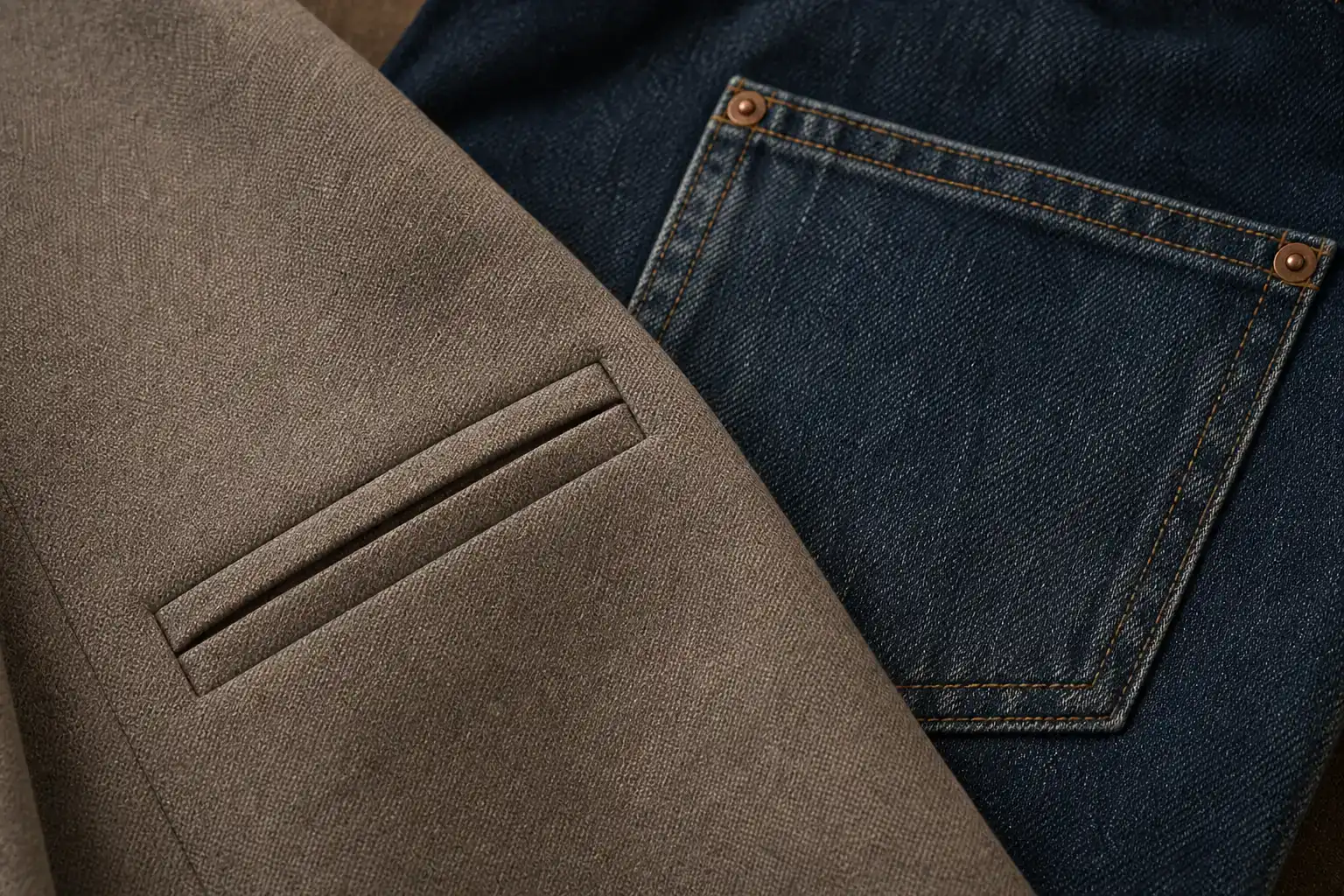
Three construction families provide a practical map for many garment pockets. A patch pocket is applied on top of the garment, so most of its outline remains visible. A set-in pocket uses an opening cut into the garment body and finished with welts or a shaped facing, while its bag hangs inside. An in-seam pocket places its opening within a seam. Familiar names such as cargo, kangaroo, jetted, flap, slant and coin describe variations, closures or placements within that working map.
The family name alone does not approve durability or cost. The buyer still needs to specify opening geometry, bag material, placement, closure, visible stitching, reinforcement intent and the evidence required for the actual load path. When a pocket fails, classify the symptom and location before assigning a cause.
| Family | Construction | Common members | Typical home |
|---|---|---|---|
| Patch | sewn on top, outline visible | patch, cargo, kangaroo, coin | jeans backs, workwear, hoodies |
| Set-in | cut into the body, welts or facing | single welt, jetted, flap, slant/western | tailoring, trouser backs, jean fronts |
| In-seam | opening hidden in an existing seam | side-seam, zip in-seam | joggers, shorts, clean trousers |
The pocket type map
The patch family: patch, cargo, kangaroo
A patch pocket hides nothing: cut, edges folded and pressed, then topstitched onto the garment where everyone can see it. Its character comes entirely from those visible choices: shape, corner radius, single or twin-needle topstitching. Back pockets on jeans are patch pockets; so are chest pockets on work shirts and the tool pockets running down a carpenter pant.
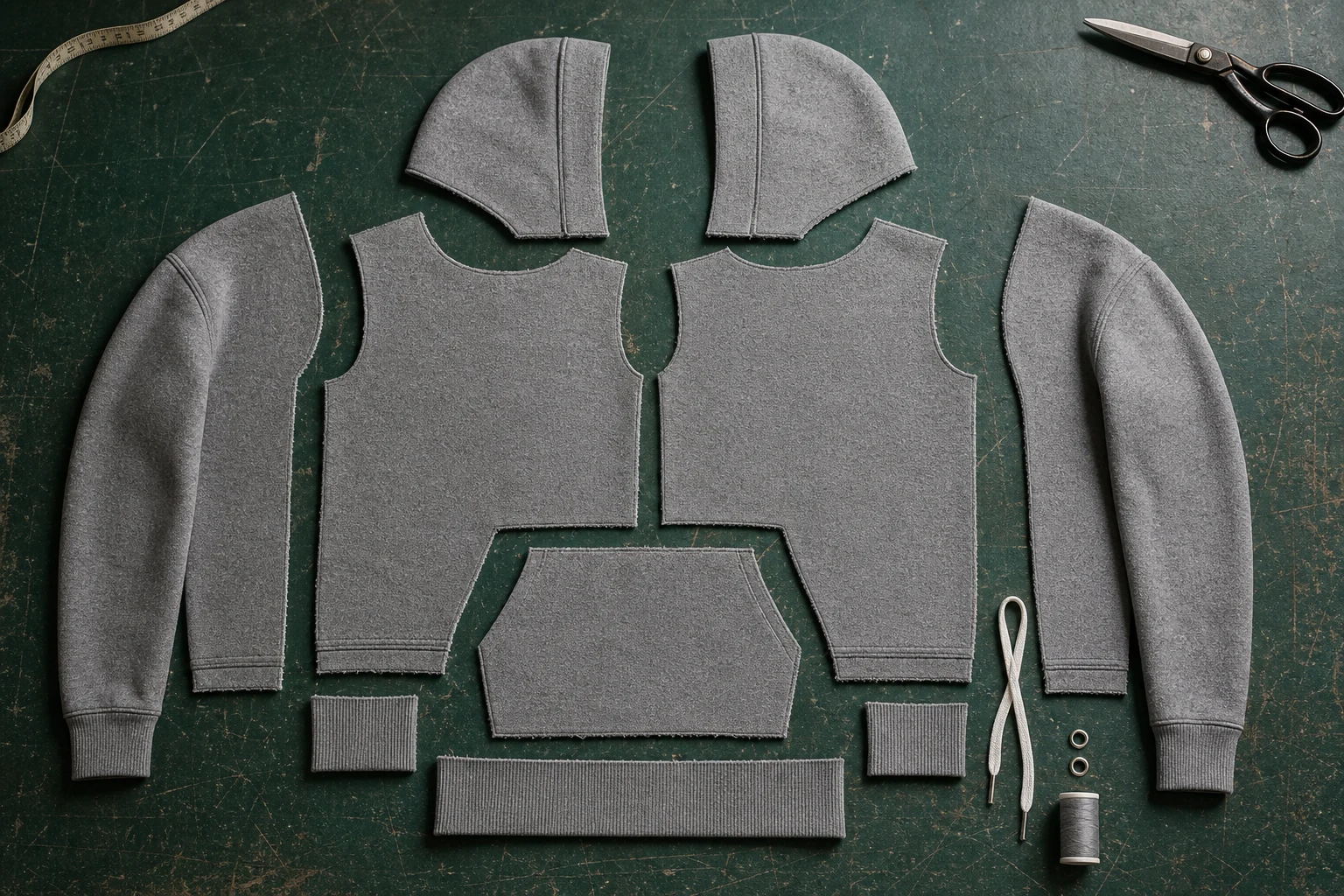
Add a side gusset so the pocket expands and a flap to close it, and the patch becomes a cargo pocket — a construction that can add gusset, flap, closure and topstitch operations, and an anchor of the utility look on styles like our multi-pocket cargo denim. Open a front patch at both sides instead of the top and you have the familiar kangaroo pocket used on many pullover hoodies (its place in the garment is mapped in our hoodie anatomy guide).
The set-in family: welt, jetted, flap, slant
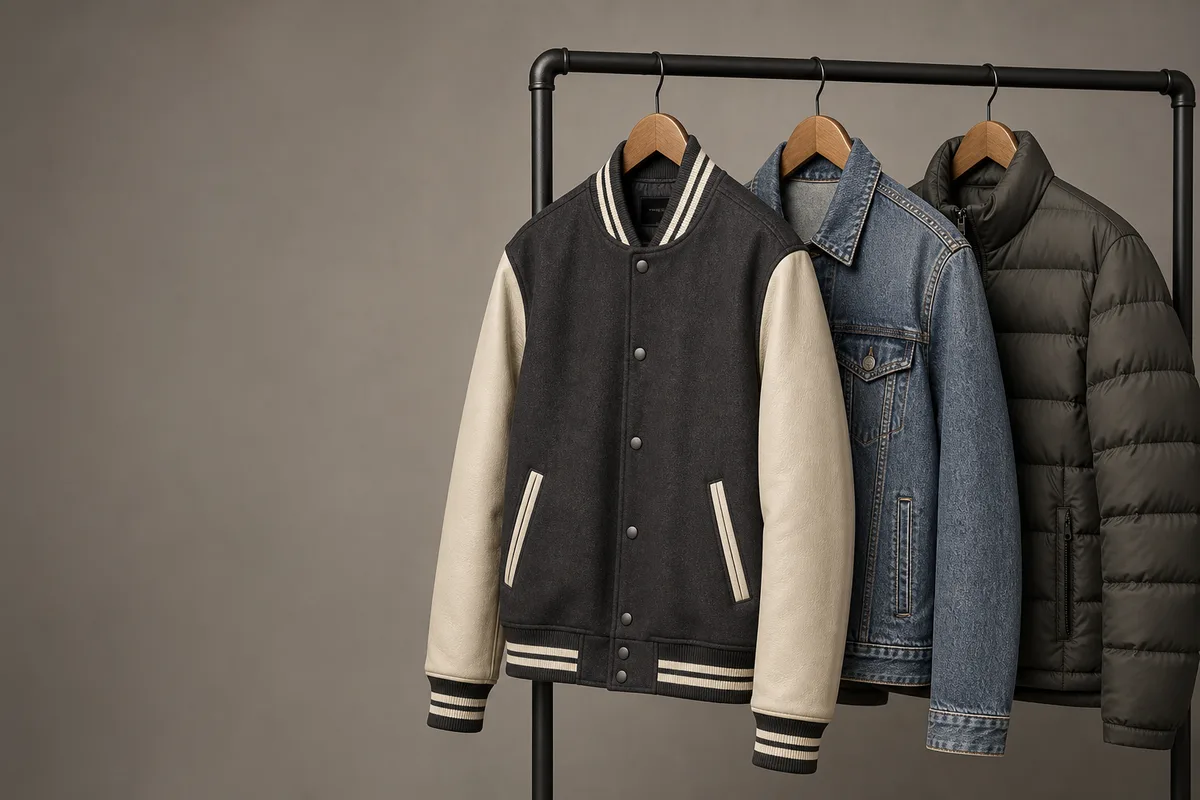
Set-in pockets flip the logic: the garment body is cut open, the opening is finished, and the pocket itself is a bag of lining hanging inside. Bind the opening with one wide strip and you have a single welt — the classic on trouser backs. Two narrow lips meeting in the middle make a double welt, also called jetted or besom — the discreet slot on tailored jackets and the side pockets on many varsity jackets. Hang a shaped flap over either and you have the flap pocket that dress coats and jacket programs default to. Finish the opening with a shaped facing instead of welts and you get the slant (slash) pocket on chino fronts and the curved western pocket on jeans — same family, friendlier construction.
Welted versions demand precise cutting, folding and sewing because the opening sits inside a visible panel. A crooked welt, uneven lips or damaged corner can require localized repair, component replacement or panel re-cutting depending on the construction and stage. Sample review should therefore record lip alignment, opening shape, corner condition and the inside bag rather than approving the front appearance alone.
In-seam and the zipper overlay
The in-seam pocket borrows a seam the garment already has — usually the side seam — and hangs its bag from an opening left inside it. Done well it is visually discreet, which is the point: this construction is common on sweatpants and joggers, shorts and clean-front trousers.
A zipper is a closure that can be integrated with different pocket constructions rather than a separate construction family. It may close a patch, set-in or seam-based opening. Our heavyweight canvas work jacket is a visual reference for zippered utility pockets; the actual closure length, tape, slider, attachment and opening construction still need project-specific approval.
The five-pocket standard, briefly
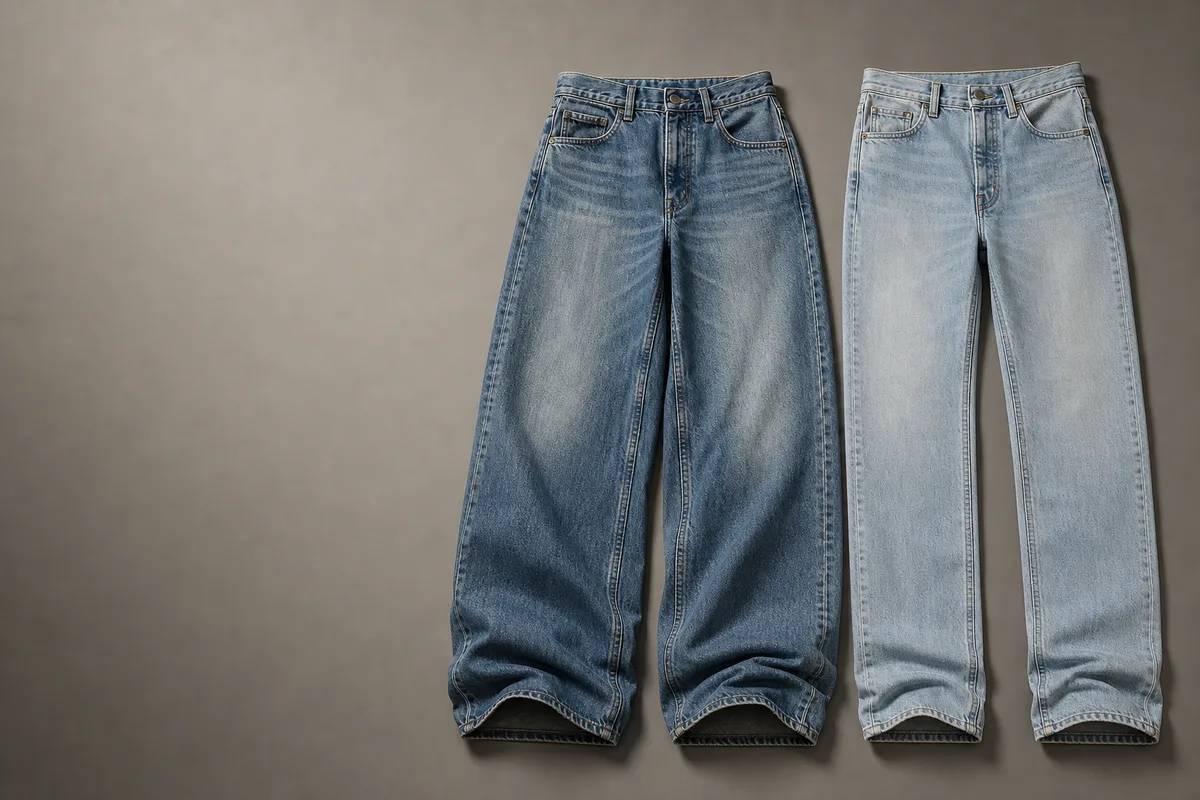
Jeans are their own small system: two curved front pockets (faced set-in, the western branch of the family above), a small coin pocket patched inside the right one, and two back patch pockets — five, and the term "5-pocket" survives as shorthand for the whole classic jean, like our baggy embroidered wide-leg. Levi Strauss & Co. traces the small front pocket to a watch pocket and explains that adding the second back pocket in 1901 made the layout a five-pocket design. Today the small pocket also functions as a recognizable detail. The fits and blocks those five pockets sit on are mapped in the denim fits and cuts guide.
What changes the sewing quote?
Pocket cost follows the actual operation sequence and material list, not the style name alone. Important quote drivers include:
- number of pocket components and mirrored pairs;
- fold-and-press work, templates and placement accuracy;
- opening cuts, welts, facings and corner finishing;
- gussets, pleats, flaps, zippers, snaps or hook-and-loop closures;
- bag material, binding or overedge treatment;
- single- or multi-row visible topstitching;
- reinforcement type and placement; and
- pattern matching, wash effects and inspection requirements.
An in-seam construction can share part of an existing seam operation, but a shaped bag, zipper, binding or difficult access may add work. A patch can be efficient on suitable equipment at volume, yet a curved shape, pattern match or several stitch rows changes the sequence. Welted and gusseted constructions generally contain more components and precision operations, but the factory should quote the approved design rather than a generic ranking.
Specify reinforcement by its intended load path and approved construction, not by assuming every corner needs the same bartack. The bartack placement guide owns reinforcement decisions, while the stitch and seam guide owns stitch formation and SPI. Identify the pocket bag by BOM material, construction, color, finish and edge treatment; do not substitute a generic “pocketing” label for approved evidence.
Diagnosing pocket-bag failure and opening distortion
“Pocket failure” is a symptom group, not a root cause. Inspect the outside and inside before deciding whether the issue belongs to reinforcement, stitching, seam behavior, pocketing fabric or opening geometry.
| Visible symptom | Evidence to capture | Route for the next check |
|---|---|---|
| Local break at an opening end | Front/back photos, load direction, reinforcement and surrounding fabric | Reinforcement placement, stitch rupture or body-fabric damage |
| Bag seam opens | Stitch remains, thread break, seam allowance, fabric/yarn movement | Stitch/seam construction or seam-slippage evidence |
| Pocketing tears away from the seam | Tear path, material identity, edge finish and specimen state | Pocketing strength/condition and seam interaction |
| Opening waves, gaps or twists | Relaxed and worn views, pattern shape, interfacing, pressing and wash state | Pattern, differential feed, finish or cleansing response |
| Welt lips distort or corners open | Lip/corner geometry plus inside construction | Cutting, folding, sewing and localized reinforcement |
Record the style, size, material and sample version; exact failure location; direction of the applied load; face fabric and bag material; seam, stitch and reinforcement construction; and whether the symptom appeared before or after washing. A front-only photo cannot show whether the thread broke, the seam opened, yarns displaced or the fabric tore.
ASTM D7506/D7506M evaluates certain localized fabric weaknesses caused by bartacking at pocket areas. It is not a complete pocket-bag or pocket-opening durability test. ASTM D1683/D1683M addresses failure in sewn seams of woven fabrics, while ISO 13935 and ISO 13936 have defined seam-force and yarn-slippage scopes. The applicable method and buyer criterion must match the material and component being investigated; a straight-seam method should not be silently presented as validation of every curved opening or complete pocket.
For a sample review, use an agreed component- or garment-level check where the laboratory method does not represent the complete construction. State the load or use condition, sample state, number and selection of units, observation fields and acceptance decision in the project protocol. Do not copy a universal bartack count, stitch density, pull force or pass threshold from another garment.
Speccing pockets so the quote is right
A pocket line in a tech pack should name the construction and variation, placement from controlled landmarks, opening geometry, complete bag shape/depth and material, closure, visible stitching, reinforcement intent and approved reference. A photo labelled only “side pocket” leaves the factory to infer details that affect pattern, BOM, sequence and quote.
Pocket count and construction are real cost levers on a multi-pocket style, which is why they should be settled during pattern and fit development. Production starts at 50 pieces per style; the final minimum for a specific garment depends on its fabric, colors and decoration, and a project-specific quote follows once the complete details are reviewed.
FAQ
What are the main types of pockets? Three construction families provide a useful working map: patch pockets sewn on top of the garment, set-in pockets cut into the body and finished with welts or a facing (single welt, jetted, flap, slant), and in-seam pockets placed within an existing seam. Named styles such as cargo, kangaroo and coin are variations; a zipper is a closure that can integrate with more than one construction.
What is a welt pocket? A pocket cut into the garment body whose opening is bound with fabric strips called welts, with the bag hanging inside. One wide welt makes a single-welt pocket; two narrow lips make a double-welt (jetted) pocket. It creates a discreet, tailored opening and requires precise cutting, folding and sewing.
What is the pocket on a hoodie called? The kangaroo pocket (or muff): a patch pocket applied to the lower front with openings at both sides instead of the top. It's standard on pullover hoodies; on zip-ups it becomes split pockets, one on either side of the zipper.
What is the small fifth pocket on jeans for? The small front pocket began as a watch pocket and later became commonly known as the coin pocket. Levi notes that it was not chronologically the fifth pocket: adding the second back pocket in 1901 created the five-pocket layout. Today the small pocket remains a recognizable part of that standard.
Which pocket type is most durable for workwear? There is no universally most durable pocket family. Durability depends on face and bag materials, opening geometry, load path, seam and reinforcement construction, closures, garment use and the approved evidence. Specify the intended contents and use, then test the actual pocket construction rather than selecting by name alone.
References
- Ruth E. Glock & Grace I. Kunz, Apparel Manufacturing: Sewn Product Analysis — pocket construction families, operation analysis and pocket-setter automation
- Jaeil Lee & Camille Steen, Technical Sourcebook for Apparel Designers (Fairchild) — welt/jetted pocket make methods, bag and reinforcement specification
- Levi Strauss & Co., “The Story Behind the Official Fifth Pocket” — the small front watch pocket and the 1901 addition of the second back pocket that made the layout five-pocket; retrieved 2026-08-15
- ASTM International, ASTM D7506/D7506M-17(2025), Pocket Reinforcement — scope for localized weakness caused by bartacking at pocket areas; not treated as a complete pocket durability test; retrieved 2026-08-15
- ASTM International, ASTM D1683/D1683M-22, Failure in Sewn Seams of Woven Fabrics — sewn-seam method scope; retrieved 2026-08-15
- ISO, ISO 13935-1:2014 and ISO 13935-2:2026 — seam maximum-force method scopes; retrieved 2026-08-15
- ISO, ISO 13936-1:2004, Resistance to slippage of yarns at a seam in woven fabrics — yarn-slippage method scope; retrieved 2026-08-15
- ISO, ISO 7770:2009, Textiles — Test method for assessing the smoothness appearance of seams in fabrics after cleansing — seam-appearance scope after cleansing; retrieved 2026-08-15
- Product examples are live catalog pages linked above; retrieved 2026-08-15