Shirt Collar Types: A Factory Field Guide from Band to Camp
Nine shirt collar types explained the way a sewing floor reads them — band and leaf, point length and spread, fused versus floating interfacing — so your next shirt brief names the collar instead of describing a photo.
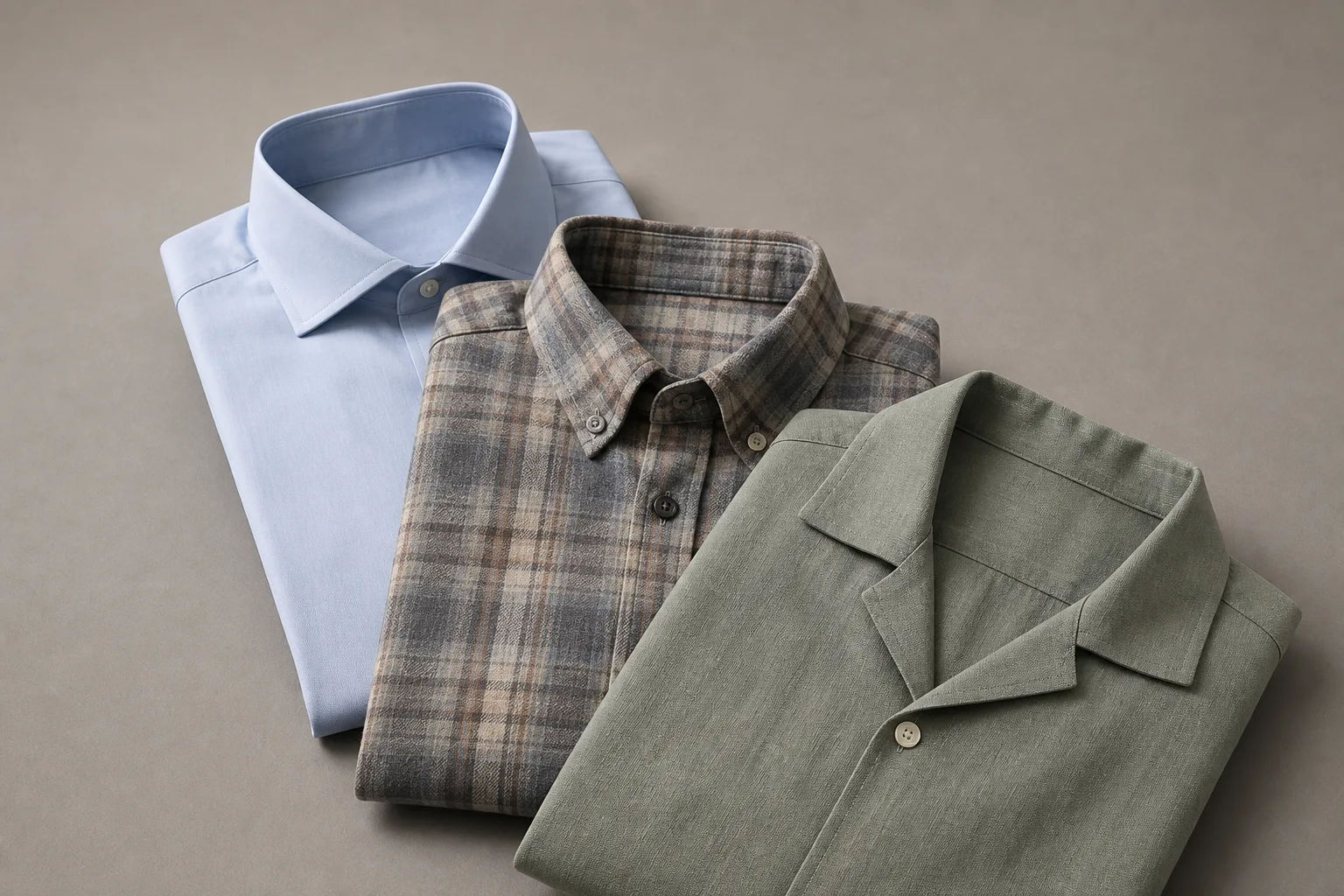
Every woven shirt collar is one of two machines. A two-piece collar stacks a leaf (the visible fold, also called the fall) on a band (the stand that circles the neck) — that family covers point, spread, cutaway, button-down and club collars, and you steer it with three numbers: point length, spread and band height. A single-layer collar keeps only one of those two pieces: keep just the stand and you have the band (mandarin) collar; keep just a flat, bandless leaf and you have the camp collar and its relatives. Name the family, then the numbers, and a factory can sew your collar without ever seeing your reference photo. This guide walks the nine types worth knowing, what each one asks of the sewing floor, and the specs that belong in a tech pack.
The shirt collar type map
Six silhouettes cover most briefs; the numbers under them do the real work. Point length on production dress collars typically runs about 6.5-9 cm, spread from under 5 cm on a narrow point collar to 15 cm and beyond on a cutaway, and band height around 3-4 cm — but those are style ranges, not rules, and the whole reason to spec them is that two collars with identical names and different numbers photograph like different shirts.
The two-piece family: point, spread, cutaway, club
The point collar (straight collar) is the default of the family — points aim mostly downward, the spread stays narrow, and the collar frames rather than performs. The semi-spread and spread open the angle between the points; the cutaway pushes it past 90 degrees until the points sweep toward the shoulders. Round the points off a point collar and you have a club collar. Construction is identical across all four: the difference is pattern shape, which is why a factory will ask for spread and point length before it asks for the name.
For completeness, the formalwear outliers: tab collars (a small strap under the points lifts the tie knot), pin collars (a bar or pin through eyelets does the same job), and the wing collar that lives on tuxedo shirts. All three are two-piece constructions a streetwear program will almost never spec — we list them so the taxonomy is honest, not because we're sewing them this season.
What actually separates a crisp collar from a limp one isn't the type — it's the interfacing. A fused collar bonds interfacing to the shell fabric with heat and pressure: uniform, sharp, efficient, and the standard on most production shirts. A sewn-in (floating) interfacing is loose inside the collar: softer roll, more labor, and the traditional choice on premium dress shirts. Fusing done wrong is also the collar's classic failure — if the interfacing and shell shrink at different rates in the wash, the collar bubbles. That's a materials-matching discipline at the factory, not a style decision, and it's one reason collar sampling matters even on a simple shirt (our shrinkage tolerance guide covers the fiber side of the same problem).
Removable collar stays — the flat blades slipped into pockets under the points — belong to this family too. Sewn-in stays are cheaper and survive nothing hotter than a domestic wash; removable stays are a small premium that keeps points flat through commercial laundering and pressing.
Button-down: the sport collar that colonized the office
Fasten a point collar's tips to small buttons on the body and you have a button-down — commonly credited to a polo-field borrowing from the 1890s, and now the standard collar on oxford and flannel shirts. For a factory it means two extra buttons, two extra buttonholes, and a placement tolerance tight enough that both points roll identically; a button-down with mismatched point roll reads instantly as a cheap shirt. Hidden button-downs move the fastening to loops under the points for the same discipline with a cleaner face.
This is the collar we sew most on custom flannel programs — a boxy heavyweight plaid button-up holds its line through washes precisely because the buttoned points keep the collar geometry fixed no matter what the fabric does.
Band and mandarin: the collar that is only a stand
Delete the leaf and the band stays: a band collar (mandarin when it stands a touch taller and meets edge-to-edge). It's the minimalist's collar and the pattern-matcher's friend — no points to align across a plaid, no stays, no roll to manage. The spec conversation shrinks to band height, edge finish, and how the top button closes. On washed and garment-dyed shirts the band collar has a second advantage: there are no fused points to bubble when the garment goes through the wash house whole (why that matters is in our vintage wash comparison).
Camp collar: the one-piece that streetwear brought back
The camp collar (Cuban, revere) is a single flat piece with no band, set into a neckline whose front facing folds back with it to form the open notch — no top button in the usual sense, sometimes a loop. Because there's no stand, the whole collar rolls soft, which is exactly the point on boxy short-sleeve builds. It's also less forgiving than it looks: the notch must sit symmetrically without a band to anchor it, and on plaids and checks the flat lie exposes any pattern mismatch at the neckline — the same reason a short-sleeve boxy plaid shirt gets its collar pattern-matched before cutting, not after.
Knit fabric runs the same single-layer idea as the polo collar — one piece, often rib-knitted as a finished trim rather than cut and sewn, as on an embroidered pique polo. It behaves like a trim, not a collar assembly, which is why polos price differently from woven shirts of similar weight.
What the sewing floor does with your choice
Every two-piece collar on our floor in Humen is built flat before it ever meets a shirt: leaf sewn and turned, points trimmed and pressed out one at a time, edge-topstitched, then set into the band, and the finished band set onto the neckline. Almost all of it runs on ISO 4915 class 301 lockstitch — the single-needle work that shirt quality talk keeps referencing (the stitch classes are mapped in our stitch and seam field guide). Point turning is the skill operation: a clipped, fully-pressed point looks sharp for the life of the shirt, while a point turned in a hurry curls within a season.
The spec lines a collar needs in a tech pack are short:
| Spec line | What it controls | What to write |
|---|---|---|
| Collar type | Pattern family (two-piece vs one-piece) | named type + reference sketch |
| Point length | Visual weight of the leaf | ~6.5-9 cm |
| Spread | Formality, tie space | <5 cm (point) to >15 cm (cutaway) |
| Band height | How tall the collar stands | ~3-4 cm |
| Interfacing | Crisp (fused) vs soft roll (floating) | fused standard; floating premium |
| Stays | Point control | none / sewn-in / removable |
| Topstitch | Edge character | 1/16" edge-stitch or 1/4" |
Six lines, and the reference photo becomes optional.
Choosing a collar for a custom program
The honest shortcut across all the shirt collar types above: match the collar to the fabric and the wash before matching it to a mood board. Crisp poplins and oxfords carry structured point and spread collars (the fabric difference is its own guide); brushed flannels and waffles want button-down points or a band that doesn't fight the fabric's softness; anything going through a garment wash argues for band or camp construction that has less fused area to distort. Production starts at 50 pieces per style; the final minimum for a specific shirt depends on its fabric, colors and decoration, and a project-specific quote follows once the complete details are reviewed — the full program lives on our custom shirt manufacturer page.
FAQ
What are the main types of shirt collars? Two families cover nearly everything, nine types between them. Two-piece collars — point, semi-spread, spread, cutaway, club, button-down — stack a visible leaf on a neckband and differ mainly in point length and spread. Single-layer collars keep one piece only: the band (mandarin) keeps just the stand, the camp/Cuban keeps a flat bandless leaf, and the knit polo collar rounds out the nine.
What is the difference between a spread collar and a point collar? Only the angle between the points. A point collar keeps the spread narrow, roughly under 5 cm, with points aiming downward; a spread collar opens the points outward, and a cutaway pushes past 90 degrees. Construction, band, and interfacing are otherwise identical — which is why factories spec the numbers, not just the name.
What is a camp collar shirt? A camp (Cuban, revere) collar is a single bandless piece set into the neckline, with the shirt's front facing folding back to form the open notch, so the whole collar lies flat. It reads relaxed because nothing makes it stand. The trade-off is precision: without a band, notch symmetry and pattern matching at the neckline have to be cut and sewn exactly right.
Do collar stays matter on a custom shirt? On structured point and spread collars, yes — stays keep points flat against wear and washing, with sewn-in stays as the economical standard and removable stays as the version that survives pressing and commercial laundering. Button-down, band, and camp collars don't use them. The buttons, the missing leaf, or the flat bandless cut do that job instead.
Why do shirt collars bubble after washing? Bubbling is almost always a fusing mismatch: the interfacing and the shell fabric shrank at different rates, so the bonded layers buckled. It's prevented at the factory by matching interfacing to fabric and verifying wash behavior at the sampling stage — one more reason a proper sample round earns its lead time.
References
- Glock & Kunz, Apparel Manufacturing: Sewn Product Analysis (4th ed., Pearson) — collar construction, interfacing and operation analysis
- Lee & Steen, Technical Sourcebook for Apparel Designers — collar styles, measurement points and tech pack conventions
- ISO 4915 stitch classification and American & Efird, ISO Stitch Terminology matrix — lockstitch class 301 and shirt seaming
Related guides
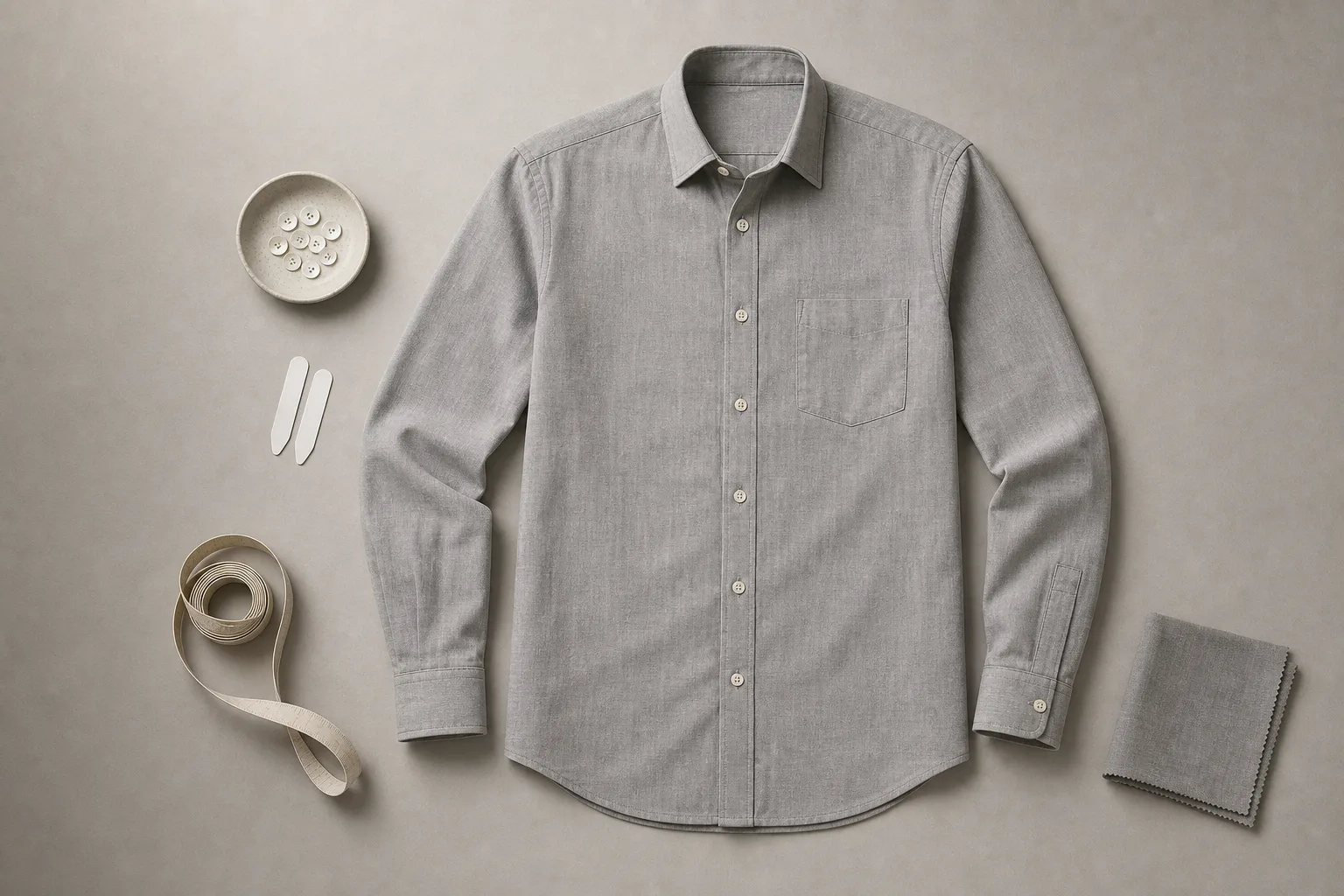 Parts of a Dress Shirt — the Vocabulary a Factory Sews From
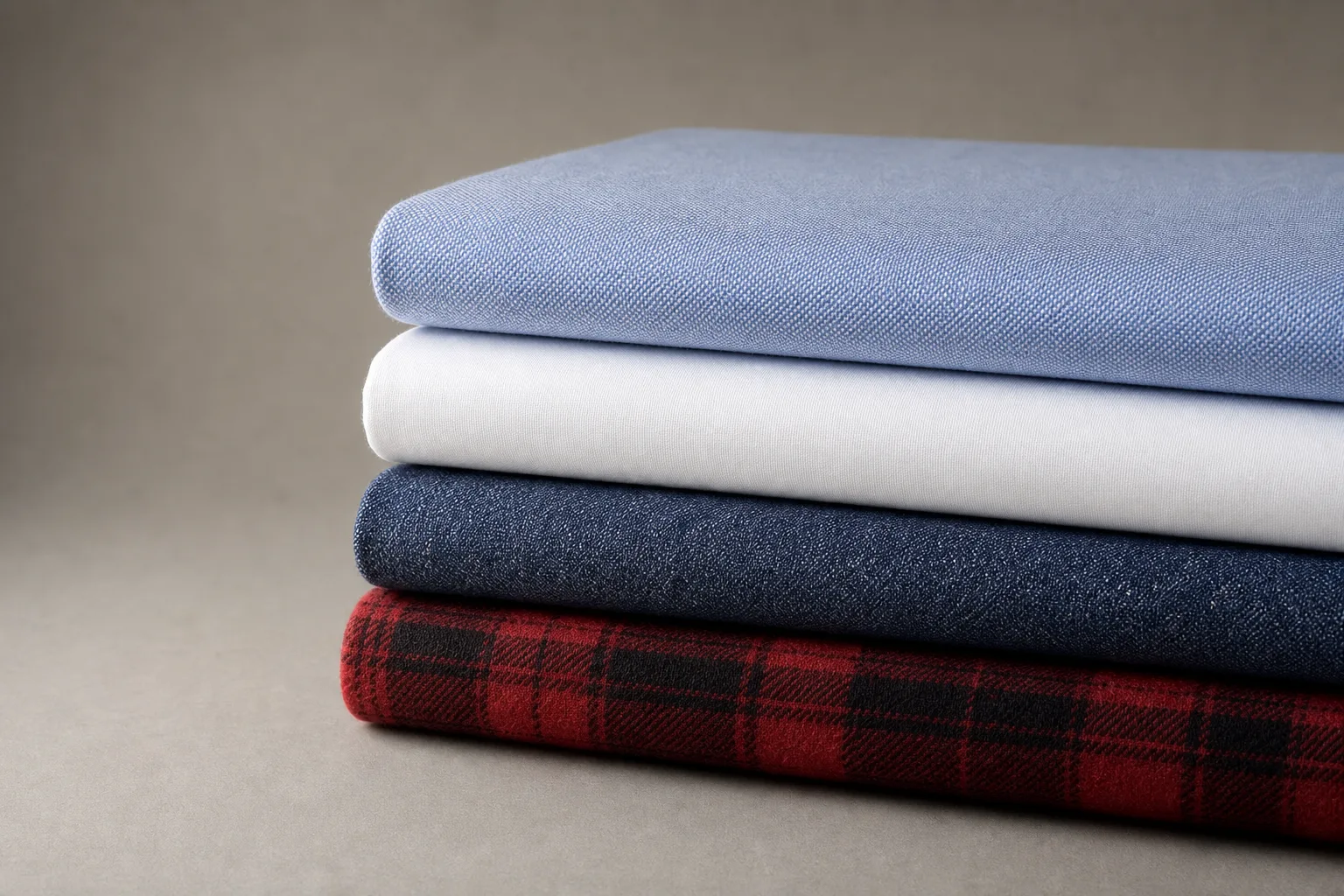 Oxford vs Poplin Shirt Fabric: How Buyers Compare Specs
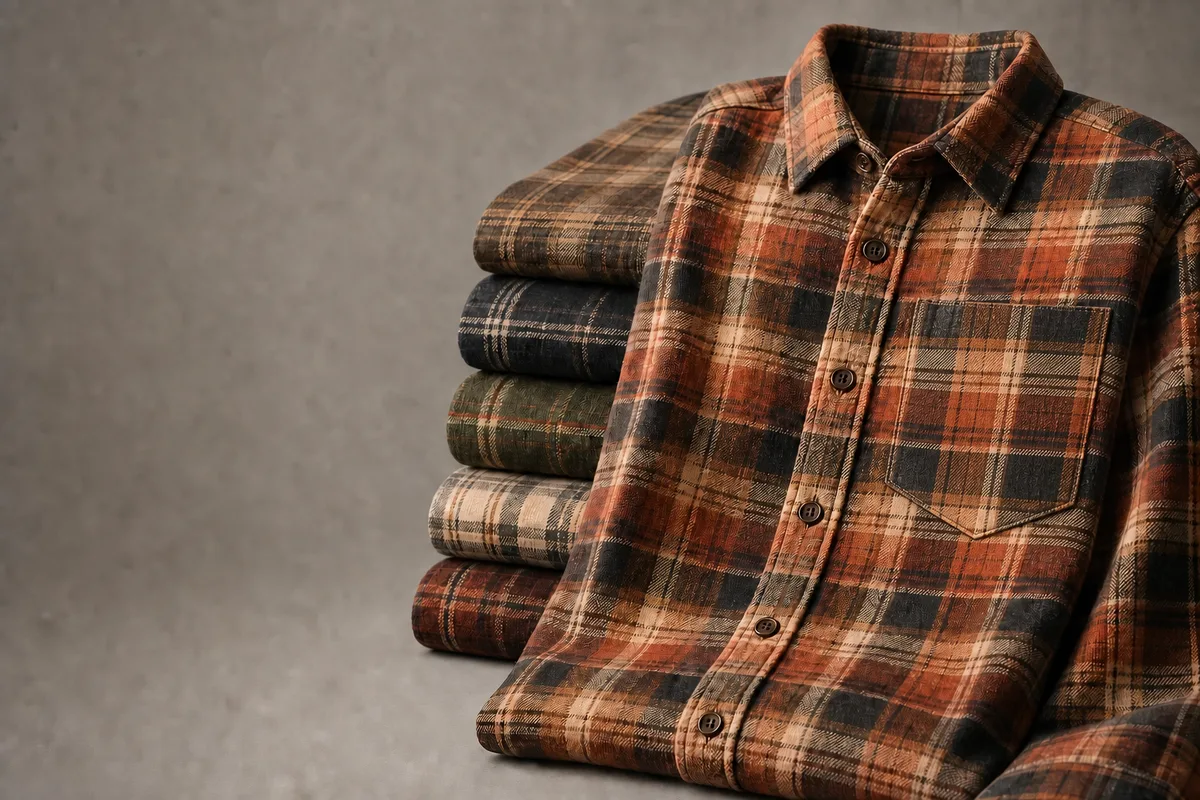 Custom Flannel and Plaid Shirt Manufacturing: Weights, Washes, Pattern Matching
 Stitch Types and Seam Quality: A Garment Approval Guide
 How to Prepare a Tech Pack a Factory Can Actually Quote