Sweatshirt vs Hoodie: What the Hood Actually Changes
Every hoodie is a sweatshirt; not every sweatshirt is a hoodie. The construction behind the terms — hood panels, drawcords, kangaroo pockets — what each adds on a sewing floor, and how brands decide between crewneck, pullover and zip for a drop.
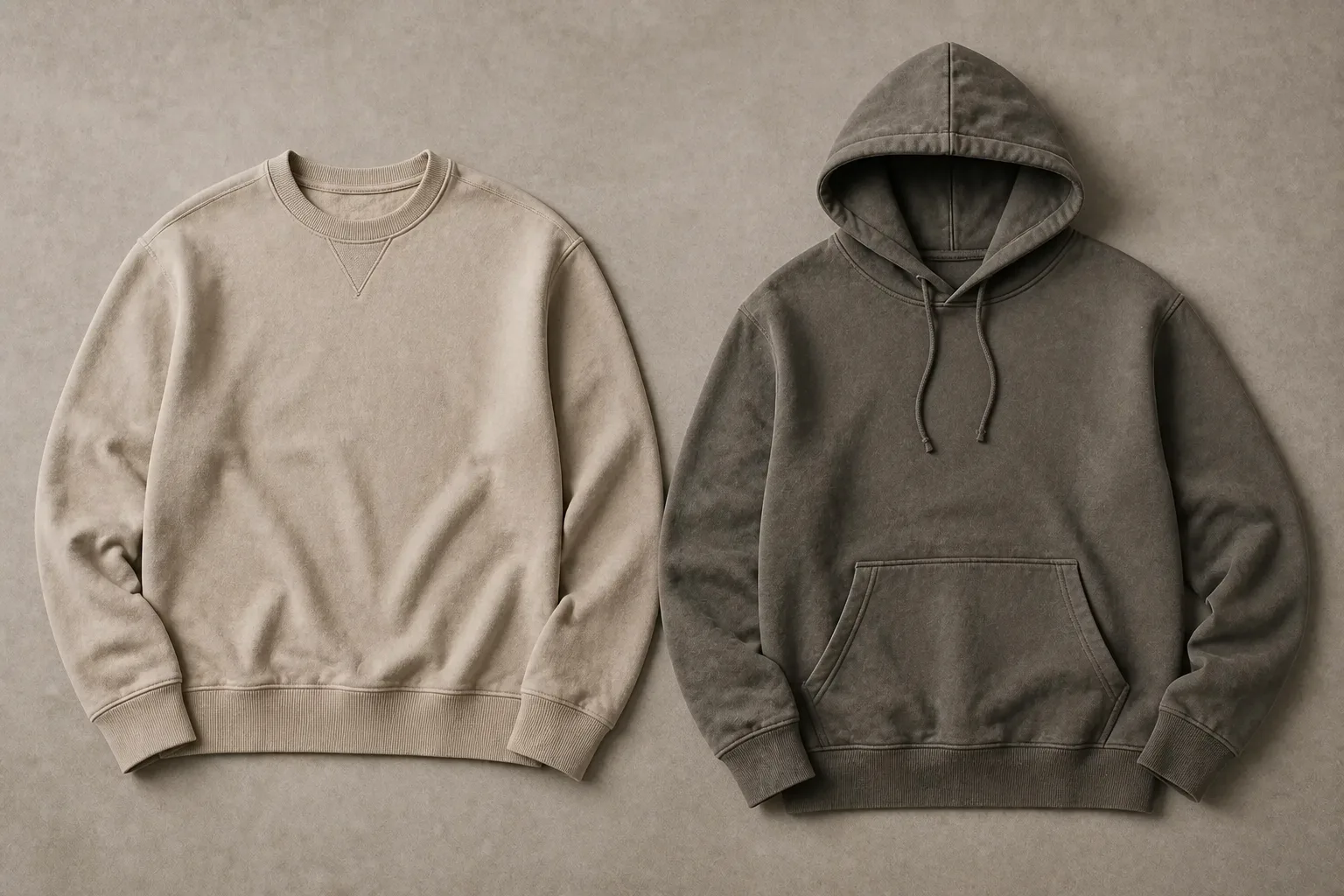
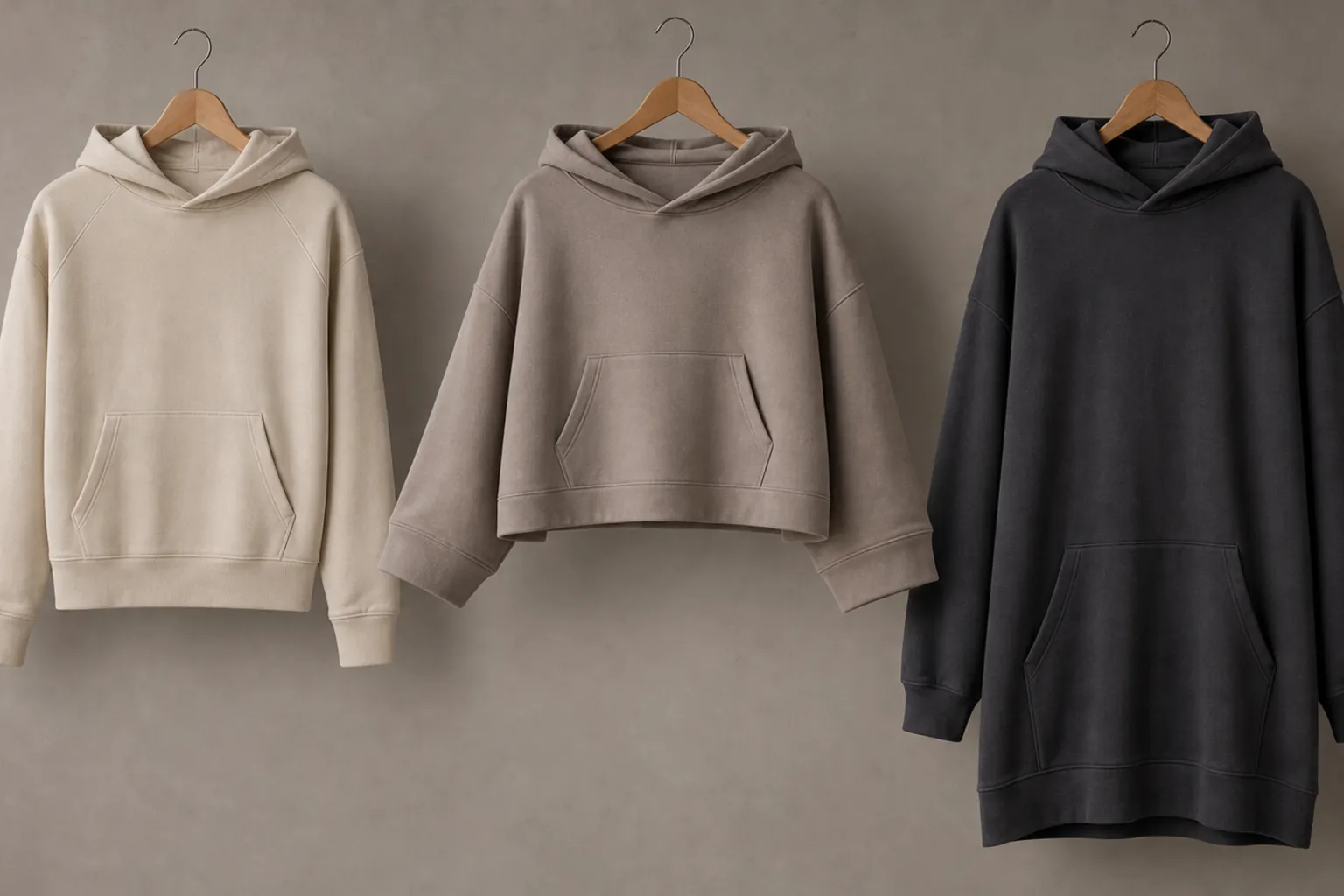
The short answer first: "sweatshirt" is the family, and a hoodie is the member of it with a hood. A crewneck sweatshirt finishes at the neck with a ribbed collar; a hoodie replaces that collar with a sewn-on hood, usually adds a drawcord and a kangaroo pocket, and comes as either a pullover or a full-zip. The word itself gives the game away — "hoodie" entered common use in the 1990s as shorthand for hooded sweatshirt.
That's the dictionary settled in one paragraph. The more useful question — the one that decides real money on a brand drop — is what those differences do to construction, cost, decoration space and how the garment reads. We sew all three silhouettes on the same fleece, so here is the comparison the way a production floor sees it.
Sweatshirt vs hoodie vs zip-up: one fabric, three garments
| Spec | Crewneck sweatshirt | Pullover hoodie | Zip-up hoodie |
|---|---|---|---|
| Neck finish | ribbed collar | hood set into neckline | hood set into neckline |
| Hood | none | 2-3 panels, lined or unlined | 2-3 panels, lined or unlined |
| Front | clean | kangaroo pocket | zipper splits pocket in two |
| Hardware | none | drawcord, eyelets or grommets, tips | drawcord hardware plus a full-length zipper |
| Reads as | clean, layers under jackets | the streetwear default | utility, on-off convenience |
| Decoration canvas | largest — chest and full upper back | chest above pocket; hood shadows the upper back | chest art must split or shift |
The fabric layer is shared: all three are usually cut from the same loop-back french terry or brushed fleece, so weight and hand-feel questions belong to the fleece guide rather than to this choice. What you're actually choosing is everything sewn onto that fabric.
What the hood adds on the sewing floor
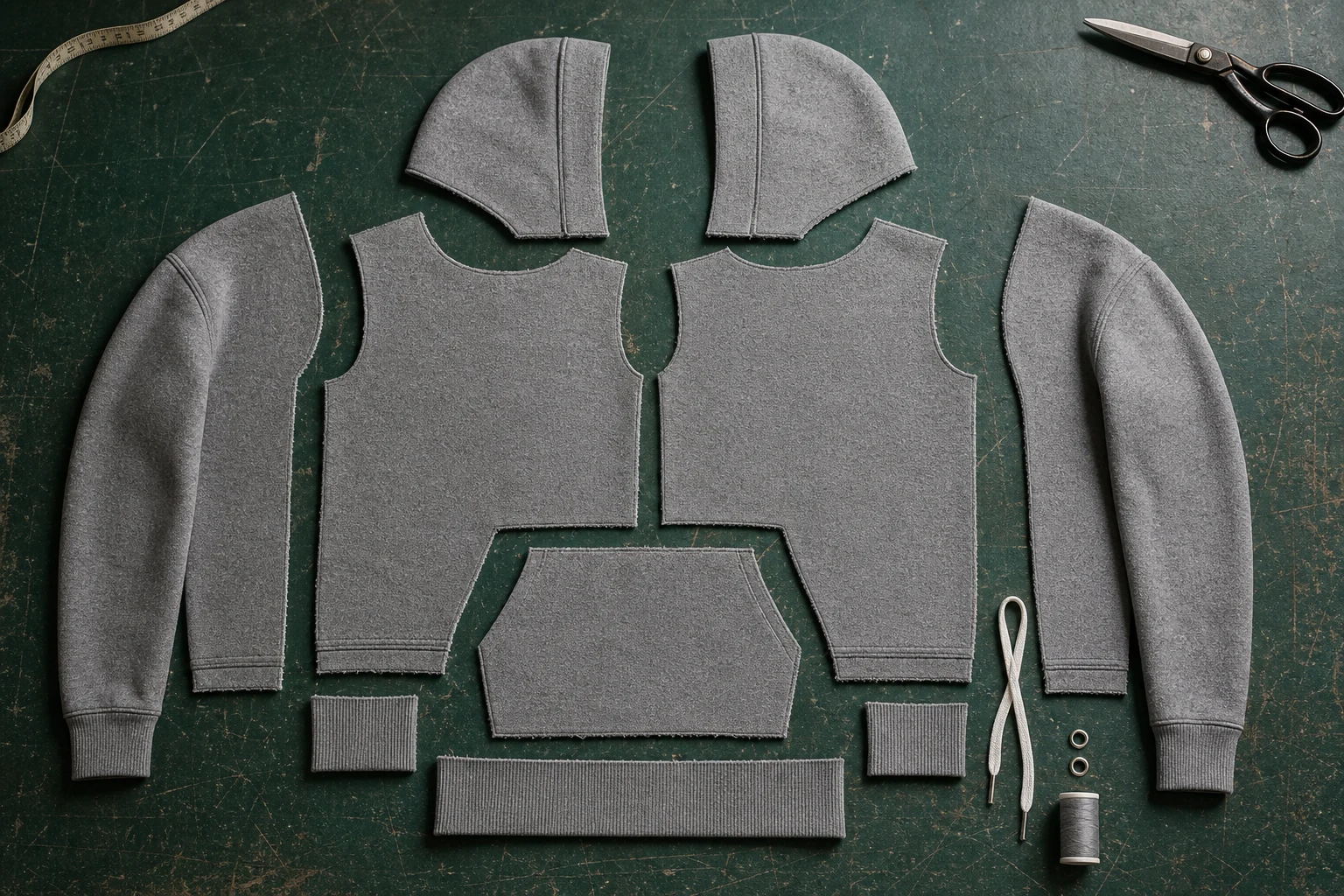
A crewneck is the simplest garment in the sweats family: body, sleeves, three ribs (collar, cuffs, hem) and it's done. Making it a hoodie adds a parts list, and every line is an operation someone sews:
- The hood itself — two panels, or three with a center gusset for a fuller shape, each seam visible from behind at eye level.
- The lining decision — an unlined hood is lighter and shows its seams; a self-lined or jersey-lined hood drapes heavier and hides them. Lining doubles the hood's fabric.
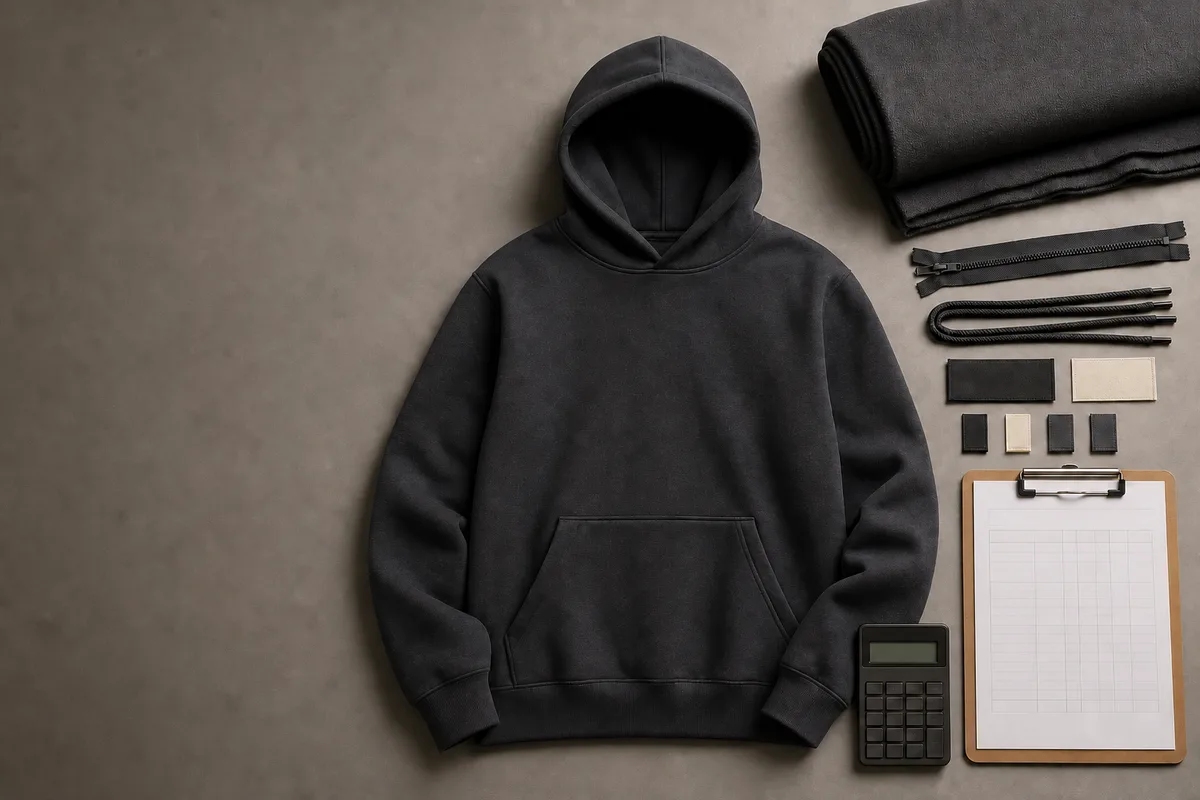
- Drawcord and exits — metal grommets or stitched eyelets, plus cord and tips. Skipping the cord entirely is a legitimate minimalist spec — our no-drawstring stone-washed pullover does exactly that. Children's sizes must skip it: US safety rules (16 CFR 1120, sizes 2T-12) restrict hood drawstrings in kids' outerwear.
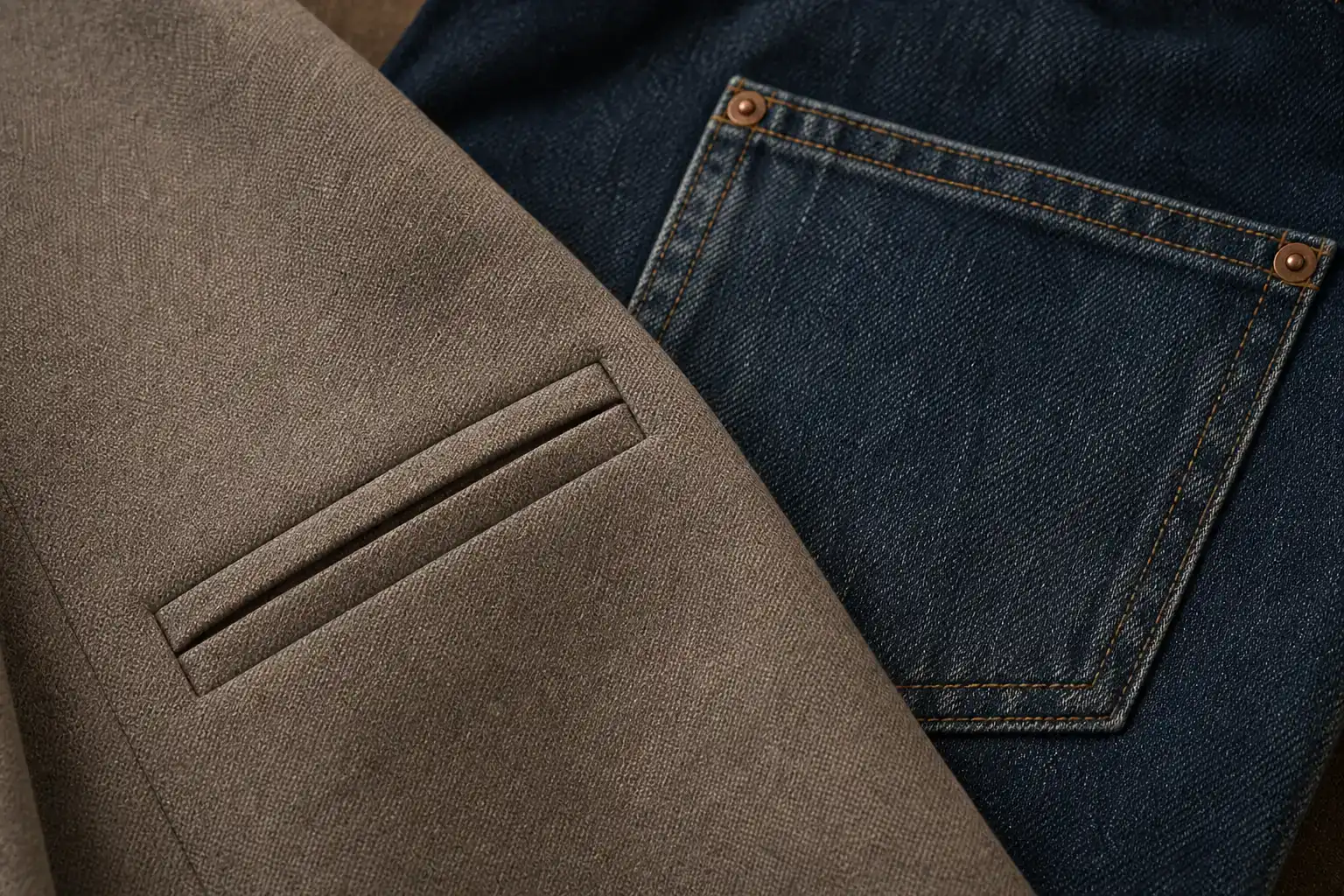
- The kangaroo pocket — a patch operation with reinforcement at four stress corners (where it sits in the wider pocket taxonomy is its own guide).
None of this is exotic, but it adds up to roughly a dozen extra operations, plus hardware, plus fabric. Cut from identical fleece at identical weight, a crewneck therefore quotes below its hoodie sibling, and the zip-up — hood plus a full-length zipper set straight — quotes above it. The full anatomy, piece by piece, is in our parts of a hoodie guide, and where the money goes is in the hoodie cost breakdown.
Crewneck vs hoodie: the decoration angle brands discover late
Artwork placement is where the choice stops being cosmetic. A crewneck is the biggest uninterrupted canvas in the category: full chest, full upper back, no cord ends dangling across the print. That's one reason merch lines that lead with big graphics often lead with crewnecks, like our cropped heavyweight pullover sweatshirt with DTG print.
Hoodies trade canvas for character. On a pullover, chest art sits above the pocket and the hood shadows the top of any back print. On a zip-up, a single chest graphic must either split across the zipper — which takes deliberate art direction — or move to sleeves, back or embroidery left and right of the zip, as on our vintage acid-wash full-zip. None of these are problems. All of them are decisions that belong before the artwork is final, not after.
Choosing for a drop
If the line is one style deep, the pullover hoodie is the category default for a reason: it's what streetwear customers picture first, and it carries logo embroidery and mid-size chest prints without any placement gymnastics. The blank canvas version is literally our plain french terry essentials pullover. If the audience skews cleaner — layering under jackets, wearing it to places with dress codes — the crewneck reads more deliberate and less default.
There's also a third answer. A two-piece drop on the same fleece, crewneck plus hoodie in matching colorways, covers both wardrobes while sharing fabric, trims and wash across the run. That consolidation is exactly what makes small-batch economics work, and the fuller playbook is in how to make merch.
Once the category is hoodie, compare the finished hoodie types; use the hoodie fits and construction guide for measurement and construction detail.
Whatever the pick, sample first. Simple samples typically take 10-18 working days after project details are confirmed; complex styles or processes take longer. Bulk typically takes 20-30 working days after approval. Production starts at 50 pieces per style; the final minimum for a specific garment depends on its fabric, colors and decoration, and a project-specific quote follows once the complete details are reviewed. The merch-specific program lives on our custom merch production page.
FAQ
Is a hoodie a sweatshirt? Yes. Sweatshirt is the umbrella term for the fleece-knit family; a hoodie is a sweatshirt with a hood attached, usually plus a drawcord and kangaroo pocket. That's why "hooded sweatshirt" and "hoodie" are the same garment — the shorter word is just newer.
What is a sweatshirt without a hood called? A crewneck (or crewneck sweatshirt), named for the ribbed round collar that finishes the neckline. It's the simplest construction in the family — body, sleeves, and ribbing at collar, cuffs and hem, with no hood, cord or pocket hardware. The V-shaped rib insert at the throat is its one traditional flourish.
Are hoodies warmer than sweatshirts? At equal fabric weight, slightly — the hood covers the head and neck, and the kangaroo pocket warms hands. But fabric weight and finish matter more: a 450 gsm brushed-fleece crewneck is warmer than a 300 gsm loop-back hoodie. Warmth is mostly a fabric spec, not a silhouette.
What is a hoodie with a zipper called? A zip-up or full-zip hoodie. Half-zip and quarter-zip variants stop partway and pull on like a pullover. The zipper adds hardware cost and splits the front panel — the main design constraint to plan artwork around — and its tape, metal or coil, matched or contrast, is a spec line of its own.
Which is better for printing, a crewneck or a hoodie? A crewneck offers the largest uninterrupted print areas — full chest and full upper back. Pullover hoodies print well above the pocket but the hood encroaches on back placements; zip-ups need artwork designed around the zipper line. For one large hero graphic, crewnecks are the easiest canvas.
References
- "Hoodie," first known use 1992 as shorthand for hooded sweatshirt — Merriam-Webster dictionary entry, retrieved 2026-07-31
- US CPSC final rule, 16 CFR 1120 — children's upper outerwear with drawstrings (Federal Register 76 FR 42502) — ASTM F1816-97 scope, sizes 2T-12
- Construction and operation counts — Jiashun production floor, Humen; product examples are live catalog pages linked above, retrieved 2026-07-31