Right-Hand, Left-Hand and Broken Twill Denim: A Brand Selection Guide
Denim twill direction changes the visible diagonal, surface reference and approval record. Learn how buyers should compare right-hand, left-hand and broken twill before sampling.
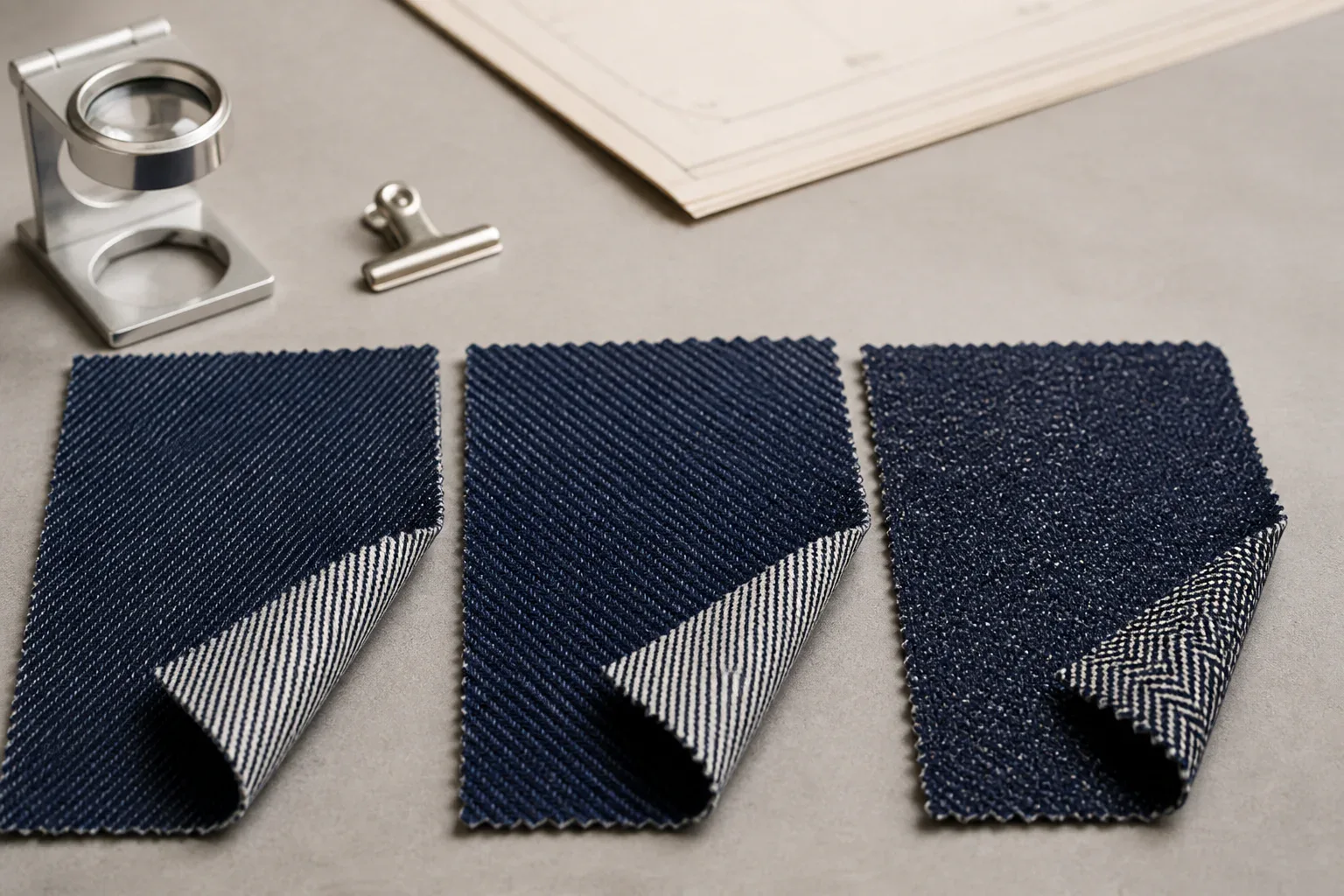
Right-hand, left-hand and broken twill are not mood-board words. They describe how the diagonal line on the denim face travels through the weave. For a clothing brand, the useful question is not which one is “best.” It is whether the selected fabric, visible face, garment pattern and wash reference are all being approved as the same physical direction.
This guide owns the twill-direction decision only. The broader denim-type owner keeps denim-family taxonomy, the denim weight guide keeps ounces and GSM, and the rigid vs stretch denim guide keeps elasticity behavior. Jiashun sources finished denim and manufactures garments; we do not claim to spin yarn, dye yarn or weave denim in-house.
What twill direction means on denim
Denim is normally a twill fabric. CottonWorks describes denim as a fabric commonly made with indigo-dyed warp yarns and undyed filling yarns, usually in a 2×1 or 3×1 twill construction. A twill weave creates diagonal ribs because warp and filling yarns interlace in an offset sequence.
On the garment face, read the diagonal as you would read a slash:
| Denim twill family | What the face diagonal does | Buyer shorthand |
|---|---|---|
| Right-hand twill | Runs upward from lower left toward upper right | RHT, Z-twill in many denim discussions |
| Left-hand twill | Runs upward from lower right toward upper left | LHT |
| Broken twill | Alternates direction, creating a zigzag or broken diagonal | Direction-changing twill |
Those names identify a weave direction. They do not prove yarn quality, fabric weight, shrinkage, color, stretch recovery, wash effect, fit or price. The how jeans are made guide explains the garment process after fabric selection; twill direction is only one field in that handoff.
Why brands care about right-hand vs left-hand twill
Most buyer briefs care for four practical reasons.
First, the surface reads differently. A close-up product shot can make the diagonal visible, especially on darker or higher-contrast indigo denim. If your reference jean has a visible handed twill, the selected fabric should be compared against that reference under the same face direction and sample state.
Second, the hand can differ between candidates. Enthusiast sources often describe left-hand twill as softening differently from right-hand twill, and broken twill as reducing the one-direction visual line. Treat that as a candidate clue, not a guarantee. Yarn twist, fabric density, finish and wash route can change hand more than the direction label alone.
Third, a direction label can hide a face-side error. A supplier swatch, cutting ticket and sample photo should identify which side is the approved face. Turning a fabric over or rotating it can change how the diagonal, shade and surface reflect light. The fabric grain, nap and one-way cutting guide owns the broader one-way cutting rule.
Fourth, some buyers connect twill direction with leg twist. That connection should be handled carefully. Twill torque can contribute to twisting behavior, but finished-garment leg twist also depends on pattern, spreading, cutting, sewing, wash and relaxation. This page records the fabric-direction decision; the jeans leg-twist guide diagnoses finished-garment rotation and its approval evidence separately.
Do not approve twill direction from a name alone
A product description that says “left-hand twill” is not enough to release bulk fabric. Build the approval around identified evidence:
| Approval field | What to record | What not to infer |
|---|---|---|
| Fabric identity | Supplier article, color, lot or sample-lot, weight and composition as provided | That every later roll matches because the name is familiar |
| Face direction | Close-up image or swatch showing the approved face diagonal | That the back side is interchangeable |
| Sample state | Greige, finished fabric, washed panel or finished garment | That pre-wash and post-wash surfaces are the same evidence |
| Garment connection | Style, pattern revision, marker/cutting direction and sample ID | That fabric approval alone approves fit |
| Finish route | Rinse, enzyme, stone, acid, overdye or other approved route | That a domestic wash predicts production wash |
The direction should travel with the fabric reference. If the fabric changes after sampling, reopen the record instead of carrying the old diagonal note into a new material.
How to inspect twill direction without overreading it
Use a simple inspection sequence. Place the swatch or garment under stable light with the approved face up. Find a clean area away from seams, distressing, embroidery and heavy wash abrasion. Read the diagonal on the face as a line, not as a shadow. If the line rises from lower left to upper right, record right-hand twill. If it rises from lower right to upper left, record left-hand twill. If the diagonal changes direction in a broken or zigzag sequence, record broken twill and attach a close-up image.
Do not use one cuff, pocket edge or heavily abraded thigh zone as the only evidence. Wash recipes can remove surface color unevenly, and distressing can make the diagonal harder to read. A seam allowance or reverse side can also mislead a remote reviewer. If the garment is already sewn, take one close photo of the visible face and one wider photo showing where the close-up was taken.
The same rule applies to remote approvals. A buyer may send a screen capture, but the production record should still connect that image to an identified fabric article, sample or reference garment. Without that identity, the team may match a diagonal while changing weight, color, stretch, finish or hand. Twill direction is useful only when it is part of a complete fabric decision.
What twill direction should not own
Twill direction can become an accidental bucket for unrelated denim questions. Keep these decisions separate:
- weight and thickness belong with the denim weight or GSM record;
- fiber content and elastane behavior belong with the composition and stretch record;
- raw, rinsed, enzyme, stone, bleach and garment-dye decisions belong with the wash route;
- leg opening, rise, inseam, outseam and stacking belong with the fit and pattern record;
- shade, cast and wash contrast belong with color and finish approval;
- leg twist, seam torque or garment rotation belong with a finished-garment observation.
This separation matters because a fabric substitute can match one field and fail another. A new roll may have the same diagonal but a different ounce weight. A new wash may keep the right-hand direction visible but change the surface enough that the customer sees a different product. A stretch denim may share the same right-hand twill label while recovering differently after wear.
For quote and sample review, write the twill direction as one line in a larger denim fabric brief. If the buyer does not care which direction is used, say “match approved reference” or leave the field open until swatches are compared. If the buyer does care, require any substitute to show the same visible face direction before sample approval continues.
How broken twill should be specified
Broken twill is useful when a buyer wants the visual and structural language of denim without one continuous diagonal. The risk is vague wording. “Broken twill” should be backed by a close-up swatch and a written fabric identity, because different broken patterns can read differently.
Ask for:
- the approved fabric article and roll/sample identity;
- the visible face image at a scale where the broken diagonal is clear;
- the intended garment face and cutting direction;
- the wash or finish state used for approval;
- the sample ID that connects the fabric to the finished garment;
- the reopen trigger if a substitute fabric is proposed.
For a style such as a stone-washed baggy denim pant, a wide-leg embroidered denim reference or a denim jacket-and-trouser set, the product page can help locate zones and visual direction. It does not prove the hidden weave, fiber composition, weight or wash response for a new order.
Sample-to-bulk handoff for twill direction
The handoff should be boring. The sample room, fabric buyer, cutting team, wash team and merchandiser should all see the same fabric identity and face-direction note. If the sample is approved from a swatch, attach the swatch ID to the sample comment. If the sample is approved from a garment, record where the close-up was taken and which side was treated as the face. If the fabric is washed before cutting or after sewing, state which state controls the final visual approval.
Before bulk, check three points:
- Roll identity. The bulk roll or lot should match the approved fabric article and color route, not only the same twill-family label.
- Face control. Spreading and cutting instructions should identify the face side and any one-way direction rule if the surface reads differently under light.
- Substitution control. A fabric substitute should reopen swatch review, sample review or buyer confirmation according to the program's risk.
This matters more for directional, high-contrast or heavily washed denim than for a low-contrast utility fabric where the diagonal is barely visible. Still, writing the control once is simpler than resolving a disagreement after garments are cut. The buyer does not need to audit weaving. The buyer needs a record that prevents an approved right-hand, left-hand or broken-twill reference from becoming an untraceable adjective in the production file.
For repeat orders, keep the old swatch and the new swatch in the same comparison record. If the new fabric is accepted because the hand, shade and wash effect are close enough, say so directly instead of pretending it is identical. That language protects both sides: the buyer knows what changed, and the factory knows which difference was accepted rather than missed.
Do the same when the buyer changes only the wash brief. A stronger wash can hide or exaggerate the diagonal, so the approved direction should be checked again on the final sample state before bulk comments are closed and before any repeat-order shorthand is allowed by merchandising or sourcing teams internally.
When a shipment contains more than one fabric lot, keep the observation tied to the inspected roll, panel or garment instead of describing the whole order from one close-up. Record the affected identity and quantity, hold only the scope supported by the evidence, and route any lot-level decision to the agreed inspection plan. That preserves the narrow purpose of this page: confirming the approved visible twill direction without pretending one sample proves every roll, wash batch or finished garment.
Buyer checklist before sampling
Use this checklist before you ask a factory to develop the first denim sample:
- The reference garment or swatch shows the visible diagonal clearly.
- The buyer has stated whether right-hand, left-hand, broken twill or “match reference” controls the decision.
- The approved face is identified; no one is assuming the reverse side can be used.
- Weight, composition, stretch behavior and finish route are recorded as separate fields.
- The sample state is named: fabric swatch, washed swatch, garment-development sample or final sample.
- Pattern and marker direction are not left to verbal memory.
- Any leg-twist concern is recorded as a finished-garment test or observation, not as a fabric-name promise.
- Substitute fabric requires written review before bulk cutting.
Copyable denim twill direction brief
Style / revision:
Reference garment or swatch:
Requested twill direction: right-hand / left-hand / broken / match reference
Approved face photo or swatch ID:
Fabric supplier article / color / sample-lot:
Weight and units:
Fiber declaration:
Stretch direction and behavior record, if applicable:
Finish or wash state used for approval:
Pattern and cutting-direction notes:
Sample ID that will confirm the decision:
Open questions or substitution triggers:
The goal is not to turn the buyer into a weaver. It is to prevent a visually specific denim direction from becoming a loose adjective inside the quote.
FAQ
Is right-hand twill better than left-hand twill denim? No. They are different weave directions. The better choice depends on the approved fabric, desired surface, wash route, fit and sample result. Do not choose by direction name alone.
Does left-hand twill always feel softer? Not always. Some left-hand twill denims are marketed or experienced as softening differently, but yarn twist, density, finishing and wash state also affect hand. Compare identified swatches and samples.
What is broken twill denim? Broken twill alternates the diagonal direction instead of running continuously one way. Specify it with a close-up swatch, fabric identity and approved face reference, not just the phrase.
Can twill direction cause leg twist? Twill torque can be part of the discussion, but finished leg twist also involves pattern, spreading, cutting, sewing, washing and relaxation. Record fabric direction separately, then use the jeans leg-twist owner for garment-rotation evidence.
Can Jiashun make jeans in these denim types? Jiashun can review finished denim candidates, garment fit, wash direction, trims and sample sequencing for custom men's denim programs. The exact fabric source, construction and approval evidence are confirmed for the project.
Should twill direction be written in the tech pack? Yes, when the visible diagonal is part of the approved reference. Put it beside fabric identity, approved face, sample state and wash route so a later substitute cannot inherit the old direction by name only.
References
- CottonWorks, Denim Basics and Denim Construction — denim construction, yarn-dyeing and twill context.
- ISO, ISO 7211-1:1984 — methods for presenting weave diagrams and plans; Edition 1 was reconfirmed in 2023.
- ASTM International, ASTM D3776/D3776M-20(2025) — mass per unit area, relevant when weight is recorded separately from twill direction.
- ASTM International, Textile Standards list — current textile-method listings including stretch-property standards.
Related guides
 Types of Denim Fabric: A Factory Guide to Reading the Cloth
 Denim Weight Explained: Oz, GSM and Choosing the Right Cloth for Your Jeans
 Rigid vs Stretch Denim: What Brands Should Specify
 Denim Fits for Streetwear: What to Spec Before the First Sample
 Denim Washes Explained: Stone, Enzyme, Acid and Sun-Fade — and How to Approve Them