Fabric Wrinkle Recovery: How Buyers Compare Test Evidence
Compare induced-wrinkle appearance and crease-recovery-angle evidence without confusing wrinkle recovery with stretch recovery, drape, shrinkage or laundering appearance.
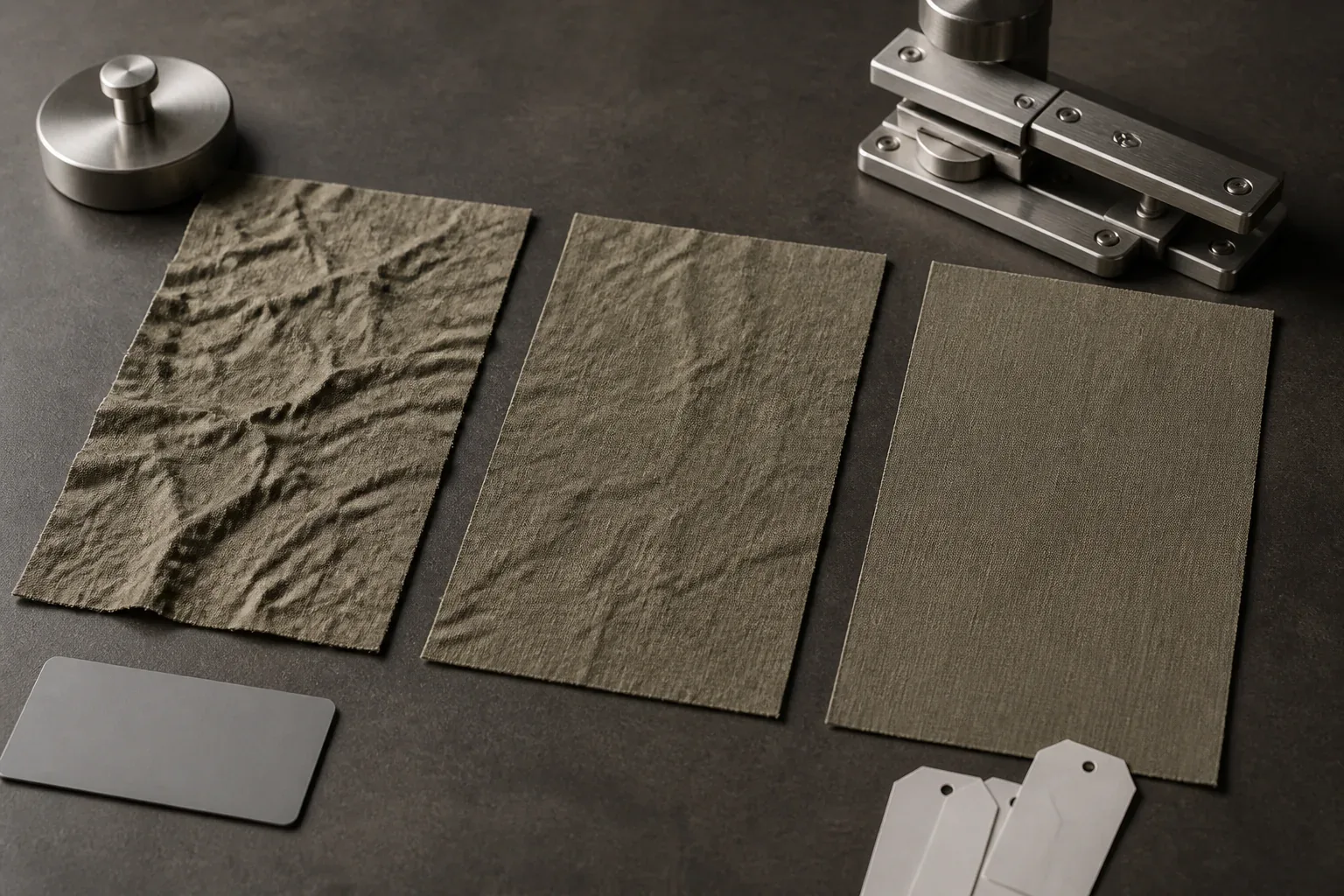
Fabric wrinkle recovery describes how an identified fabric looks or moves back after a defined wrinkling or creasing procedure. A useful buyer requirement names the material and its state, the method and edition, the reported result, the comparison basis and the acceptance decision. It does not begin with a fiber stereotype or a universal grade.
This guide owns that buyer-side specification and evidence record. It does not own stretch and growth recovery, dimensional shrinkage, drape, garment-wash defects, finished-garment pressing defects or consumer care instructions. Those properties can affect the same garment, but their methods and decisions are not interchangeable.
Start With the Result You Actually Need
“Wrinkles too much” can point to several different jobs. Before ordering a test, write the use case in observable terms. A travel shirt may need its body panel to present acceptably after a defined packing simulation. A trouser program may need two candidate fabrics compared after the same crease procedure. A jacket brief may simply require a matched sample review at the elbow after ordinary wear handling. Those are not automatically the same test request.
Keep the neighboring properties visible:
| Buyer concern | Evidence family | What it does not prove |
|---|---|---|
| Appearance after induced wrinkling | Named appearance method, identified specimen state and applicable reference scale | Stretch recovery, shrinkage or the cause of the appearance |
| Recovery from a defined fold or crease | Named angle method, specimen orientation, timing and reported angle | Whole-garment smoothness or performance across unrelated fabrics |
| Residual enlargement after extension | Stretch, growth and recovery method for the applicable construction | Resistance to an induced wrinkle |
| Size change after washing and drying | Dimensional-change method and measurement points | Crease recovery or drape |
| Falling and reshaping under gravity | Drape comparison or applicable drape method | Recovery after a prescribed crease |
| Appearance after laundering | Named wash-and-dry appearance method and finished state | The same result as an unwashed induced-wrinkle test |
This separation prevents a common specification error: asking for “good recovery,” receiving a stretch report and assuming that the fabric will also resist visible wrinkling.
Choose the Evidence Route Before Setting a Limit
Two established method families illustrate why the method name matters.
Appearance after induced wrinkling
ISO 9867:2022 specifies an appearance method for evaluating textile fabrics after induced wrinkling and states that it applies to all kinds of textile fabrics. The public scope establishes what the method evaluates; it does not publish one buyer pass grade for every garment.
The official summary for AATCC TM128-2017e2 describes a specimen wrinkled under standard atmospheric conditions with a predetermined load for a prescribed period. It is then reconditioned and evaluated against three-dimensional reference standards. The summary also allows evaluation in an original, unwashed state or after home laundering. That last option makes the tested state essential: an unwashed result and a post-laundering result are not the same submission.
An appearance rating answers an appearance question under that procedure. It should be reported with the method, edition, specimen identity and state rather than reduced to “wrinkle test passed.”
Recovery angle after a defined crease
ISO 2313-1:2021 specifies a horizontally folded specimen method for determining recovery angle. Its public abstract warns that results for textile fabrics of very different kinds cannot be compared directly. ISO 2313-2:2021 covers a vertically folded specimen route and specifies observation for a stated time after the creasing load is removed.
The two part numbers are not decorative details. A report must identify which procedure produced the number. An angle from one route should not be silently inserted into a criterion written for another route, and neither angle should be converted into an appearance grade unless the applicable method and agreed specification explicitly provide that relationship.
Identify the Fabric State Before Comparing Results
A property result belongs to a specimen, not to the word cotton, poplin or polyester. Record enough identity to retrieve or reproduce the submitted material:
- supplier and article or internal material code;
- fiber declaration where verified, construction and applicable yarn information;
- color, dye or finish lot and face/back identification;
- finished mass and other approved material identifiers where relevant;
- roll, cut or specimen identity;
- greige, dyed, printed, coated, washed, heat-set or otherwise finished state;
- prior care or conditioning exposure included in the submission; and
- machine and cross directions or another orientation required by the chosen method.
The fabric swatch approval checklist retains the identity and limited approval of the physical material. A wrinkle result can be attached to that record, but it does not expand one small swatch into automatic approval of every bulk roll.
State control is especially important when a finish changes between development and production. If a test was run on an unfinished lab sample but bulk will be dyed, washed or otherwise finished, label the result as development evidence. Do not present it as finished-bulk conformity.
Build a Comparable Test Request
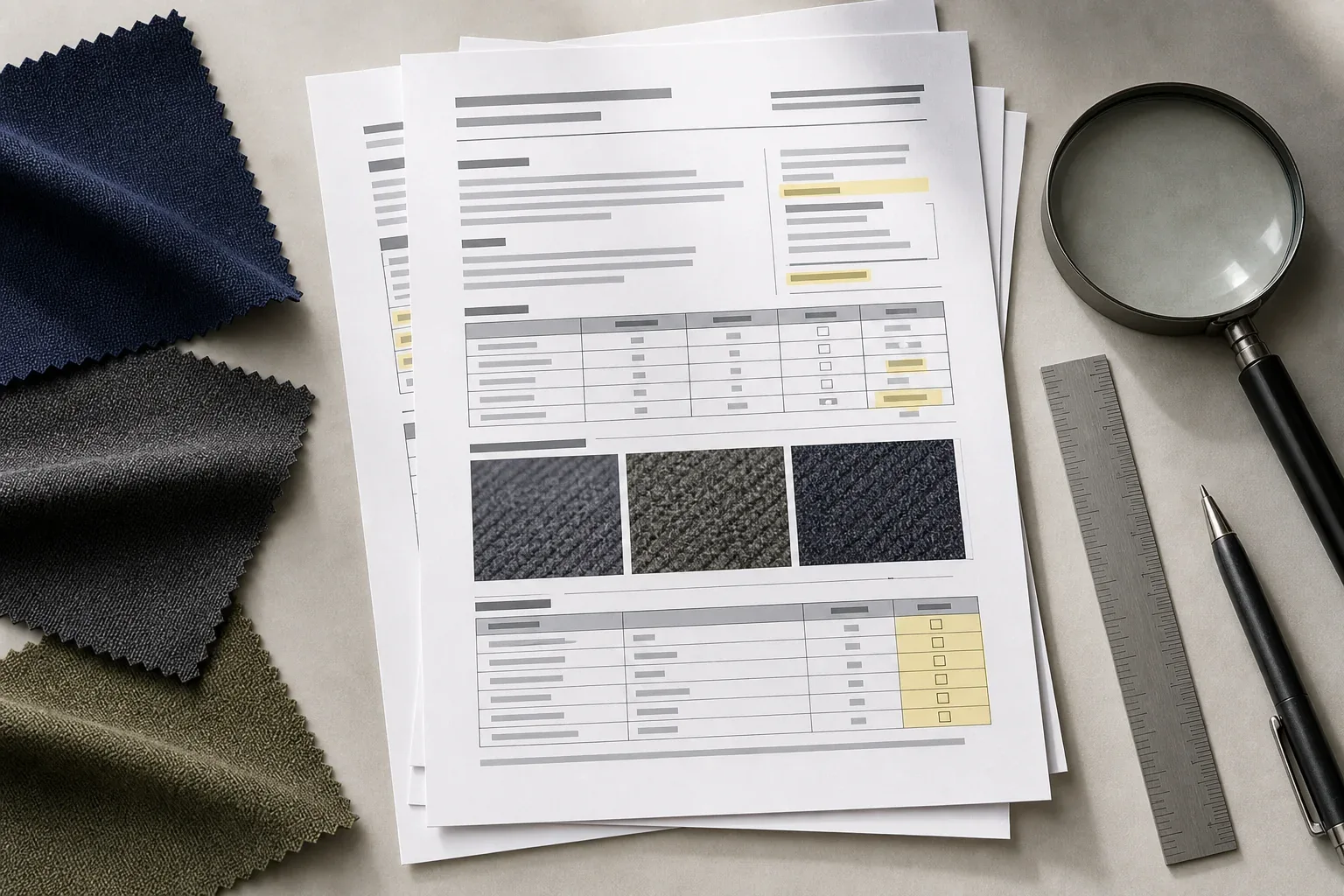
A laboratory can only answer the question that was actually ordered. Use the current full standard and a qualified laboratory for the procedure; a public abstract is not an operating instruction. The buyer-facing request and returned report should make these fields traceable:
Material, color, lot and specimen IDs:
Material state and prior exposure:
Method, edition, part and applicable option:
Specimen orientation and number of individual results:
Conditioning and test atmosphere stated by the method:
Creasing or wrinkling procedure used:
Recovery or reconditioning interval:
Reported result and units or reference grade:
Comparison control or approved target:
Buyer acceptance criterion and decision owner:
Test date, laboratory and report revision:
Not every method uses every field in the same way. The point is to preserve the chosen procedure rather than invent a hybrid. If a laboratory report uses a house method, ask for the procedure identifier, revision and relationship—if any—to the contractual method. “Similar to ISO” is not enough to assume equivalence.
The textile test report guide owns report identity, accreditation scope, method/version checks and the separation of measured results from buyer acceptance. This wrinkle guide supplies the property-specific questions that should be attached to that report review.
Read the Result Without Inventing a Universal Grade
A higher recovery angle can indicate more recovery under the stated crease-angle procedure, but it is not a universal quality ladder for every fabric or silhouette. ISO 2313-1’s public comparability warning matters in sourcing: a crisp shirting, a dense canvas and a brushed knit may serve different garment jobs even if all three produce numbers.
Use one of three bounded comparison models:
- Candidate against candidate: two identified fabrics tested by the same method, state and relevant conditions for one garment brief.
- Candidate against an approved control: a new submission compared with a retained material or report that has the same decision scope.
- Candidate against a contractual criterion: a value or appearance requirement chosen for the project, with the method and state written beside it.
If the method, edition, specimen state or orientation differs, stop and reconcile those differences before ranking the results. A difference in the final number may be a material difference, a procedure difference or both.
Also separate result from cause. A fabric that retains a visible wrinkle may involve fiber, yarn, construction, finish, moisture history or other conditions. The result alone does not identify which variable produced it. A correction trial should change a named variable, retain an unchanged control and repeat the applicable evidence before anyone assigns cause.
Translate Fabric Evidence Into a Garment Decision
A flat specimen does not contain a garment’s seams, layers, pockets, rib, lining, body geometry or use pattern. After a suitable fabric result, confirm the intended appearance on a production-representative sample.
Map the zones before review. A cropped flannel button-up can help a remote team name the front body, placket, sleeve and elbow. A canvas work jacket adds a structured front, collar, pockets and multi-layer intersections. Stone-washed baggy denim pants provide knee, seat, pocket and hem zones for a trouser discussion.
Those product pages are visual location references only. Their names and photographs do not prove fiber content, finish, wrinkle recovery, a laboratory result or approval for another order.
For the actual sample, identify the garment revision and fabric lot, agree on the handling or wear state, and photograph the same zone under repeatable light and orientation. Compare it with the approved reference. Record whether the lab result is supporting evidence, a contractual gate or only a development screen. Do not claim that one passing specimen proves every size, panel direction, production lot or care state.
Keep Adjacent Canonical Owners Separate
Wrinkle recovery can sit beside other fabric and garment concerns without absorbing them:
- Use the knit versus woven guide for structure, stretch, growth and dimensional recovery by direction. Denim-specific stretch selection remains with the rigid versus stretch denim guide.
- Use the fabric drape specification for the way a supported material falls and reshapes under gravity.
- Use the cotton shrinkage tolerance guide for dimensional change after a named wash-and-dry route.
- Use the garment wash defect guide when a crease or fold line first appears in a garment-level wash or finish investigation.
- Use the garment pressing defect guide for a double, displaced or unintended crease found after finished-garment pressing.
Post-laundering smoothness is also its own named job. AATCC TM124-2018 is intended to determine fabric smoothness appearance after home laundering procedures. Do not substitute that title for an induced-wrinkle method, and do not let this article become a consumer-care instruction page merely because a tested state includes laundering.
Reopen Approval When a Controlling Input Changes
An approval should name what it releases. Reopen or assess the evidence when the controlling scope changes, including:
- material supplier article, construction or verified composition;
- color, finish, coating, wash route or heat history;
- production lot where the agreement is lot-specific;
- method, edition, part, option or specimen orientation;
- garment panel direction, backing, lining or layer stack;
- approved care exposure or finished state; or
- acceptance criterion, target garment or market claim.
Do not automatically reject a complete program because one trial differs. Hold the identified scope, preserve the original specimens and reports, define the changed condition and return the new result to the named decision owner. The sample approval checklist owns the physical revision and disposition record.
Buyer Checklist for Wrinkle-Recovery Evidence
- The property is wrinkle or crease recovery, not stretch recovery, shrinkage or drape.
- The material, color, lot, face and finished state are identifiable.
- The method, edition, part and applicable option are stated.
- Specimen orientation, conditioning and recovery interval are traceable where applicable.
- Individual results and the reported summary remain attached to the report.
- The acceptance criterion belongs to the buyer specification, not an invented universal grade.
- Compared results use compatible methods and material states.
- A laboratory result is not presented as automatic whole-garment or whole-lot approval.
- The garment zones and production-representative sample are identified.
- Changes that reopen approval are written before bulk release.
Jiashun can help connect a fabric brief, physical reference, named test request and garment-sample review through its fabric sourcing process. The material identity, method, criterion and production scope remain project-specific.
Frequently Asked Questions About Fabric Wrinkle Recovery
What is fabric wrinkle recovery?
It is the appearance or movement back observed after an identified fabric specimen undergoes a defined wrinkling or creasing procedure. A useful result includes the specimen state, named method, timing or reconditioning required by that method, reported outcome and buyer decision rule.
Is wrinkle recovery the same as stretch recovery?
No. Stretch recovery concerns movement back toward an original dimension after extension, while wrinkle or crease recovery concerns appearance or angle after a defined wrinkling or folding procedure. One result should not be used as a substitute for the other.
Does a higher crease recovery angle always mean a better fabric?
No. It is a result under a stated procedure, not a universal quality score. The garment use, fabric kind, method, specimen state and comparison scope still control the decision. ISO 2313-1 specifically warns against direct comparison of very different kinds of textile fabrics.
Can an ISO 9867 appearance result be compared with an ISO 2313 angle?
Not as if they were the same unit. ISO 9867 evaluates appearance after induced wrinkling, while ISO 2313 reports recovery angle from a defined folded-specimen procedure. Keep the method-specific result and criterion attached to each record.
Does a passing fabric test approve the finished garment?
Not by itself. A garment adds pattern geometry, seams, layers, direction, use zones and a production lot. Use the fabric result as the agreed specification requires, then review the identified garment sample and state before releasing the applicable scope.
What should a buyer put in a wrinkle-recovery requirement?
Name the material and state, method and edition, applicable part or option, orientation and report fields, comparison control, acceptance criterion, garment use and decision owner. Also state which changes require a new submission or review.
References
- International Organization for Standardization. ISO 9867:2022, Textiles — Evaluation of the wrinkle recovery of fabrics — Appearance method. Current published edition checked August 22, 2026.
- AATCC. TM128-2017e2, Wrinkle Recovery of Fabrics: Appearance Method. Official public purpose, scope and principle summary checked August 22, 2026.
- International Organization for Standardization. ISO 2313-1:2021, horizontal folded-specimen recovery-angle method. Published edition under systematic review when checked August 22, 2026.
- International Organization for Standardization. ISO 2313-2:2021, vertical folded-specimen recovery-angle method. Published edition under systematic review when checked August 22, 2026.
- AATCC. TM124-2018, Smoothness Appearance of Fabrics after Home Laundering. Cited only to bound the separate laundering-appearance job.