How to Start a Streetwear Brand in 2026: The Production Playbook
Logos and lookbooks are the easy half. This is the other half — tech packs, samples, minimums, real budgets and real timelines — from the factory side of the table.
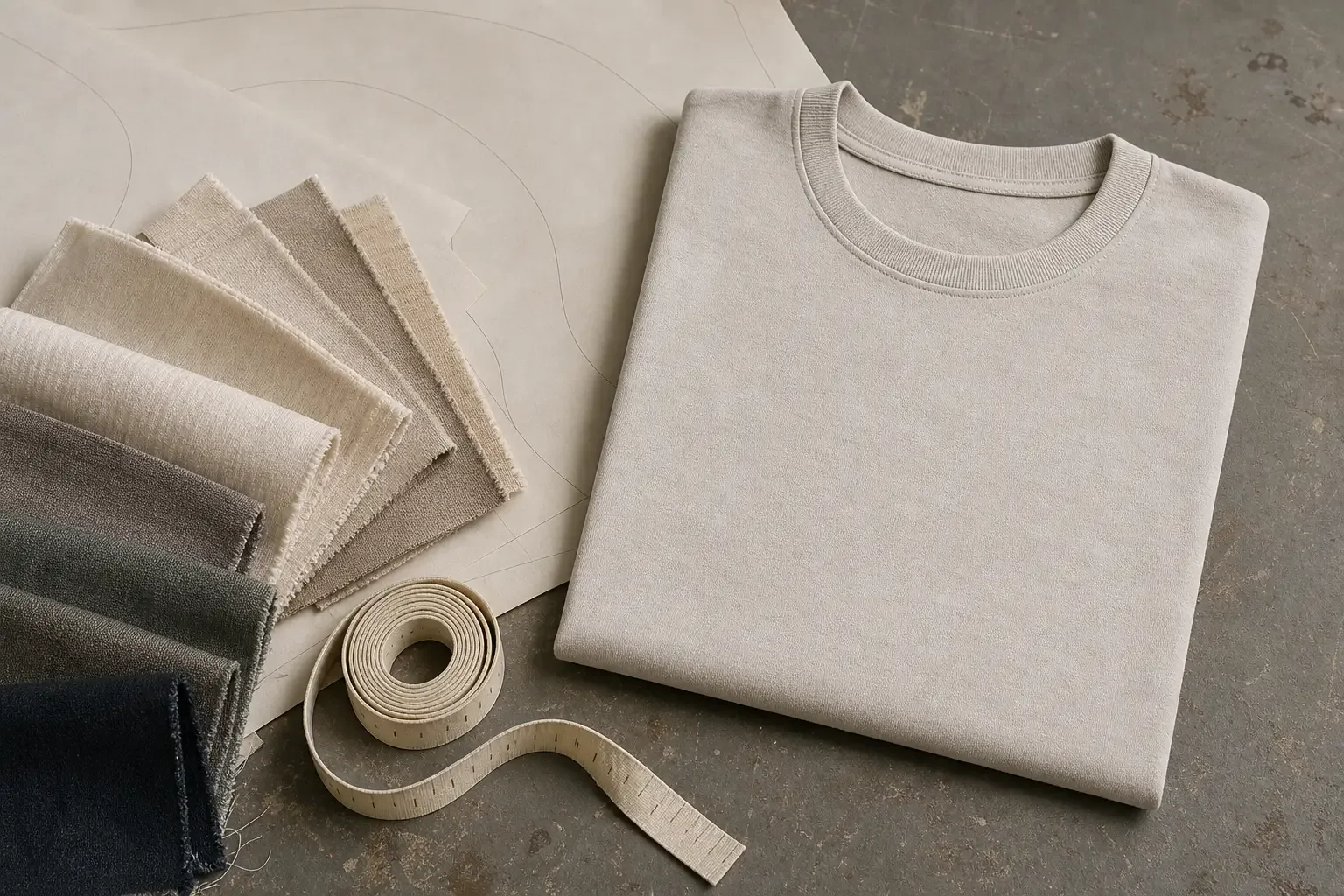
The production math, before anything else. A first custom style at a 50-piece minimum lands just under USD 900 for a heavyweight tee, about USD 1,600 for a hoodie, and USD 1,550-2,300 for washed denim or outerwear at Jiashun Clothing's published tier pricing, plus a project-specific quoted amount per sample. Simple samples typically take 10-18 working days after project details are confirmed; complex styles or processes take longer. Bulk typically takes 20-30 working days after approval. Including a revision round and freight, plan from the formal project schedule rather than adding the two production ranges alone.
That's the whole secret, honestly. Starting a streetwear brand isn't gated by capital or connections anymore; it's gated by whether you can run a disciplined development process. Here is that process, step by step, from the side of the table that builds the garments.
First, a quick look at the market you're stepping into — because two of its numbers should change how you build.
What you're actually building in 2026
Streetwear stopped being a niche years ago; the numbers now describe a mainstream industry. Fortune Business Insights, in its July 2026 update, sizes the global streetwear market at USD 397.97 billion for 2026, up from USD 371.09 billion in 2025, and projects USD 734.05 billion by 2034 at a 7.95% annual growth rate — with the US accounting for roughly USD 62.3 billion of the 2026 figure. Read that from the factory floor and it means two things at once: there is genuine room for new brands, and every customer you want has already handled enough heavyweight cotton to judge yours by touch. A growing market raises the ceiling and the bar in the same motion.
The second number is about what happens to your garments after the first sale. The ThredUp 2026 Resale Report measured secondhand apparel growing 13% in 2025 and projects USD 393 billion globally by 2030 — roughly twice the growth rate of apparel overall, with Gen Z and millennials driving more than 70% of that growth. For a streetwear founder, this cuts in your favor if you build for it. Garments that hold their shape, their print, and their wash keep circulating with your label in the collar, and every resold piece introduces the brand to a buyer you never paid to reach. Garments that don't hold up exit the loop quietly. Durability isn't just a values statement in 2026; it's distribution.
So what you're actually building isn't a logo. It's a small product operation: two or three styles, developed with discipline, produced at a quality level the resale rack will vouch for, released on a schedule you control. Marketing decides how fast the brand grows; production decides whether there's a brand to grow. This playbook is the production half, in the order the work actually happens.
Step 1: define the brand before you touch a tech pack
The founders who move through production fastest can answer three questions before any garment exists: who is this for, what does it stand for, and what does that mean in fabric?
Pick the scene you're actually in. Streetwear is a federation of scenes — skate, basketball, music, car culture, workwear revival, a dozen internet subcultures — rather than one market. Design for a scene you genuinely belong to, because your first fifty buyers will be people who can tell. Authenticity here comes down to whether the audience recognizes itself in the product, not to a tone of voice.
Write the position in one sentence. "Heavyweight vintage-washed basics for the local skate scene, cut boxy, priced under your ceiling" is a position. "Elevated essentials with a streetwear edge" is a caption. The test of a real position is that it makes decisions for you: it tells you which fabrics, fits, and price points are off the table before anyone asks.
Translate identity into product language. A factory cannot execute a mood board, but it can execute "250-300 GSM boxy tee, dropped shoulder, tonal chest embroidery, enzyme-washed black." Every brand adjective you care about needs a physical translation — a silhouette, a fabric weight, a wash, a decoration — because those are the only levers a production floor has. Do this translation before design work, not after: it becomes the spine of your tech packs.
Name your first hundred customers. At a 50-piece first run, the launch problem is conviction, not reach. The group chat, the local scene, the niche community you already post in: that's the launch list. If you can't picture fifty specific people wearing the first drop, that's worth resolving before production, because no factory decision fixes a demand question.
And the definitional question, since it decides everything downstream: what makes a brand "streetwear" rather than simply casualwear is silhouette-led design, limited drop-based releases, and a direct line to a culture. All three become production decisions later — the silhouette in your pattern, the drop in your order quantity, the culture in your decoration and wash.
Step 2: set up the business side without overbuilding it
We build garments, not legal entities, so treat this section as a checklist of questions rather than legal advice — rules vary by state and country, and official sources are the ones to verify against.
Entity and licenses. Most US founders start as a sole proprietorship or a single-member LLC and formalize further as revenue grows. The LLC's practical appeal is separation between personal and business liability, plus smoother relationships with banks and payment processors. Depending on your state and city, you may also need a sales tax registration or a basic business license; requirements differ enough between states that the only reliable answer is your state's own business portal.
Relabeling needs supplier permission and market-specific review. A decorated wholesale blank is a white-label route in this guide, but the route name does not authorize label replacement. Confirm the blank supplier's terms and the rules for every sales destination. In the US, the FTC's textile and wool labeling guidance addresses fiber content, country of origin and manufacturer or dealer identity for most covered products, while separate Care Labeling Rule guidance addresses care instructions for covered clothing. The brand or importer should validate the final market copy; a factory can check manufacturability and reproduce the approved revision.
Screen the trademark before you print it. Run your brand name through the USPTO's trademark search before committing it to woven labels, and check the markets where you plan to sell. A database search is an early screen, not legal clearance or a registration decision; use qualified advice when the brand investment or conflict risk is material.
None of this needs to be finished before design work starts. It needs to be finished before your labels go to print.
Step 3: choose your production model deliberately
Several production models can support a launch. Compare the actual provider and project terms rather than treating one route as a mandatory first step:
- Print-on-demand — production and fulfillment follow the provider's catalog, options, pricing and order terms. It can test a design without committing to a factory bulk run; verify the current blank, branding, fulfillment and landed-cost scope.
- Decorated blanks — start from an identified finished garment, then add approved decoration or relabeling within the supplier's terms. Development, quantity, availability, price and speed are vendor-specific. The white label vs private label guide shows which identity and change-control records to request.
- Made-to-order cut-and-sew — develop and approve a garment specification covering the applicable pattern, fabric, construction, wash, decoration and labels. Our MOQ starts at 50 pieces, with the final minimum and workable breakdown confirmed after the product, fabric, wash and customization are reviewed.
The decision does not have to follow a fixed sequence. Use the POD vs cut-and-sew guide to compare the current landed POD cost, inventory commitment, product-control requirement and a project-specific factory quote. A brand can keep different products on different routes when each product's identity, approval record and economics remain clear.
Step 4: design a first drop the math can survive
Every strong first drop we've produced started the same way: the founder could point at real garments and say "this fit, this weight, this wash — with my design language." A reference garment communicates fit, fabric hand and construction faster than any written description, and it forces the decisions a sketch lets you defer.
Two or three styles is the right first-drop width. Every additional style multiplies everything downstream — sampling cost, minimums, QC surface, unsold-inventory risk — and a tight capsule that sells out beats a wide range that trickles. Depth of conviction over breadth of coverage.
A pairing that shows up in a lot of strong first drops: a heavyweight boxy tee as the accessible entry piece, plus a hoodie as the hero that carries the drop's identity and margin. With the width set, three decisions determine most of your cost and most of your identity: how quantities are structured, what the fabric weighs, and how the garments are decorated and finished.
Why minimums exist, and how to structure around them
Minimums exist because of how garment economics work below the surface, not because a factory is being difficult. Fabric mills sell by minimum lengths and dye lots, cutting is only efficient when a marker is laid across many plies at once, and every style change stops a sewing line for setup. Below a certain quantity, those fixed costs make each piece absurdly expensive — the minimum is simply the point where the math starts working. Our MOQ starts at 50 pieces, with the final minimum depending on the product, fabric, wash, and customization; heavily washed styles can carry a higher minimum because dye and wash baths need a workable load for consistent results.
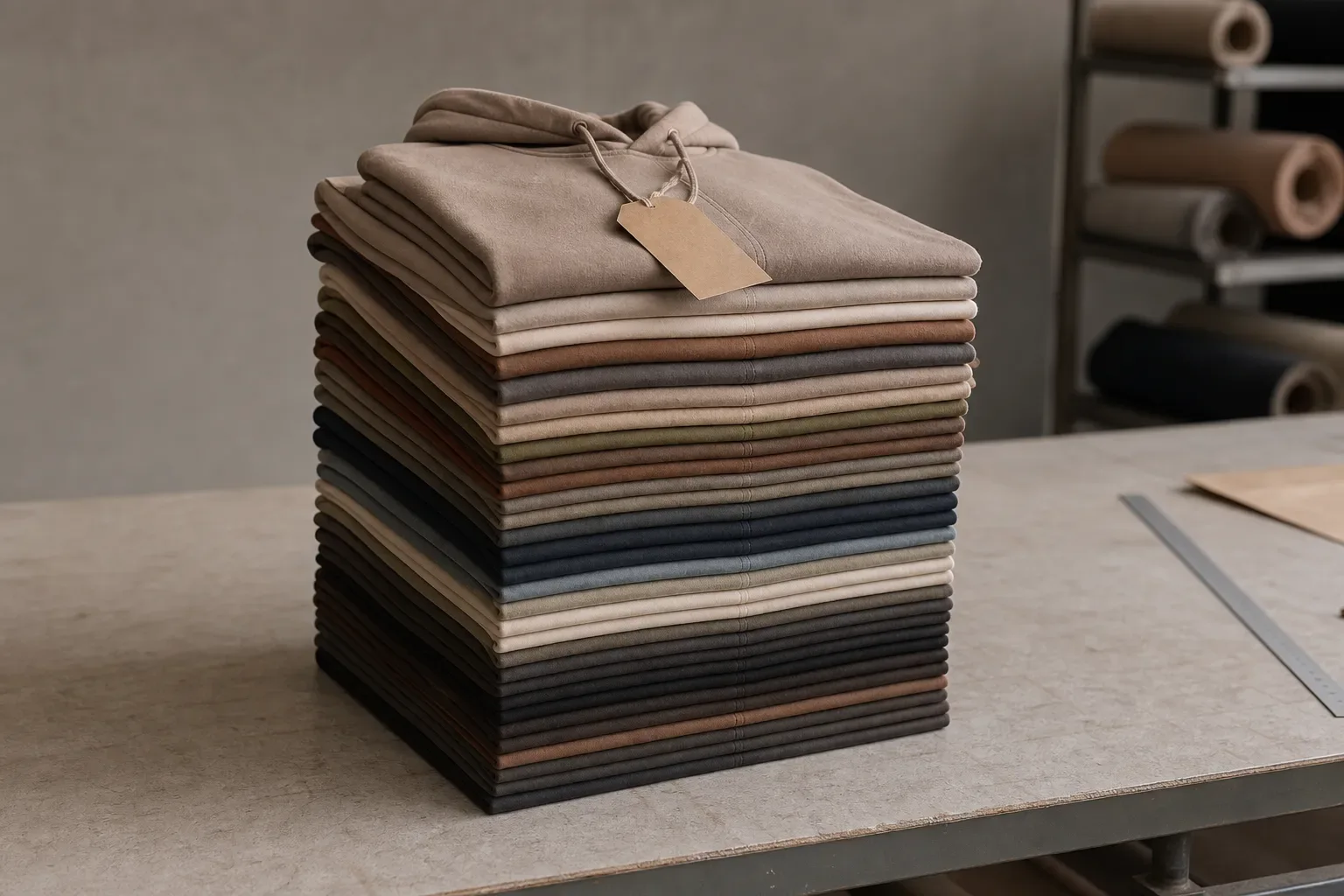
Structure the drop around that reality instead of fighting it. Three styles in three colorways each is nine minimums — 450 pieces before you've sold one. Two styles in one or two colorways each keeps the first drop between 100 and 200 pieces, concentrated on the designs you believe in most. Weight quantities toward the hero piece, keep colorways tight (black plus one is a common first-drop answer), and add width in drop two with drop one's revenue.
Pick the fabric weight on purpose
Fabric weight is the single biggest lever on how a garment feels, photographs, and costs. For streetwear tees, 200-250 GSM is the sweet spot for a structured boxy fit, with 250-300 GSM as premium-heavyweight territory. Most streetwear hoodies land in the 380-450 GSM band, with 450-500 GSM reserved for rigid, sculptural heavyweight builds. Our GSM guide for streetwear maps the full range; the compressed version is that weight and silhouette are one decision, not two. A boxy pattern in lightweight jersey collapses into "too big"; a slim pattern in heavy fleece reads stiff instead of premium.
Weight is also a cost decision. Fabric is bought by weight, it's usually the largest cost component in a cut-and-sew garment, and every extra hundred grams travels with every air shipment you ever send. Choose the weight your positioning supports, not the heaviest number a brand you admire uses.
Sourcing the fabric itself is part of what a full-service factory does: through fabric sourcing, you specify composition, weight, and knit — or send a reference garment to match — and the factory proposes options against it. Whatever you choose, confirm shrinkage behavior on the actual fabric lot, especially if your drop involves garment washing, and wash your approved samples at home the way your customers will.
Decoration and finishing: where the identity lives
Decoration decides how the drop reads from across the room, and every method has a personality. Screen printing is the streetwear default for bold graphics and takes thick ink deposits happily on heavier fabric. DTG and DTF handle photographic detail and small runs. Embroidery signals premium and carries chest hits and back pieces well on heavyweight fleece. Puff print — the raised 3D finish that dominates current heavyweight streetwear — genuinely wants a heavy fleece base to cure flat and even. The full method comparison covers choosing between them at your fabric weight and quantities.
Finishing is streetwear's other signature. Garment washing and dyeing — stone wash, enzyme wash, sun fade, acid wash — is how a brand-new garment reads like an archive piece, and it's a real production process with real consequences: washes amplify shrinkage (patterns must be cut with allowance to land on spec afterwards), shades vary within a tolerance you should agree on a physical sample, and wash-heavy styles can raise the minimum because the baths need a workable load.
The discipline that keeps budgets intact: every decoration placement is a setup cost, a labor line, and a QC surface. Two strong, well-executed decorations beat five mediocre ones — on cost, on inspection risk, and usually on design. Decide decoration per style at this stage, because it feeds directly into the next step.
Step 5: write one tech pack per style
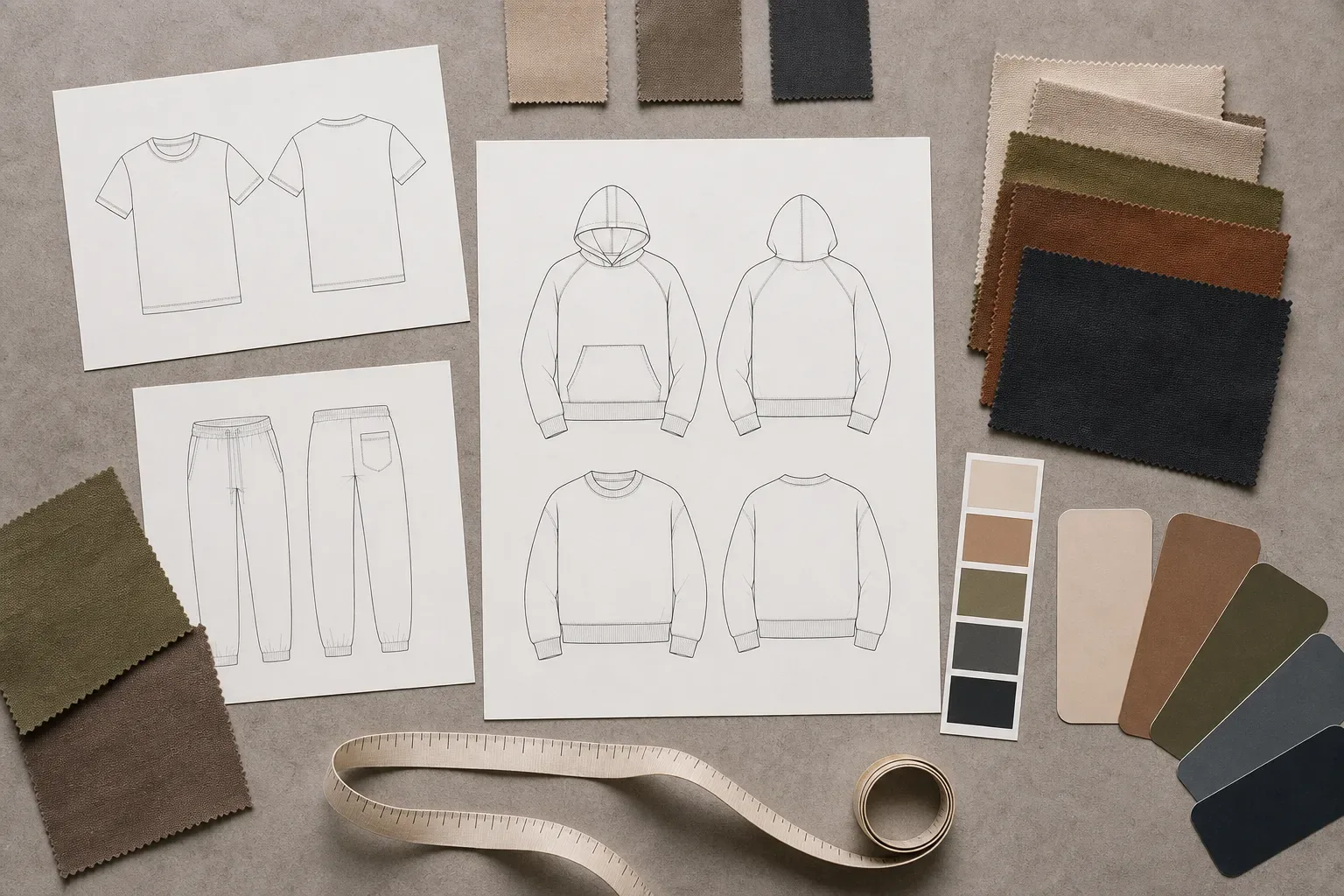
A tech pack is the contract between your idea and the factory floor: measurements by size, fabric spec, colorways, decoration placements, trims and labels, packing. Ours don't need to be beautiful — they need to be complete, and what a factory actually reads in a tech pack is its own guide. If you're starting from AI-generated designs, turning renders into production-ready specs is its own pipeline — and the tech pack is where it lands.
The practical payoff is speed and precision: with a complete spec, we return a quote after sufficient project details are reviewed. An incomplete spec doesn't save time; it converts quoting time into a question-and-answer round.
Here's what a quotable, buildable tech pack contains at minimum:
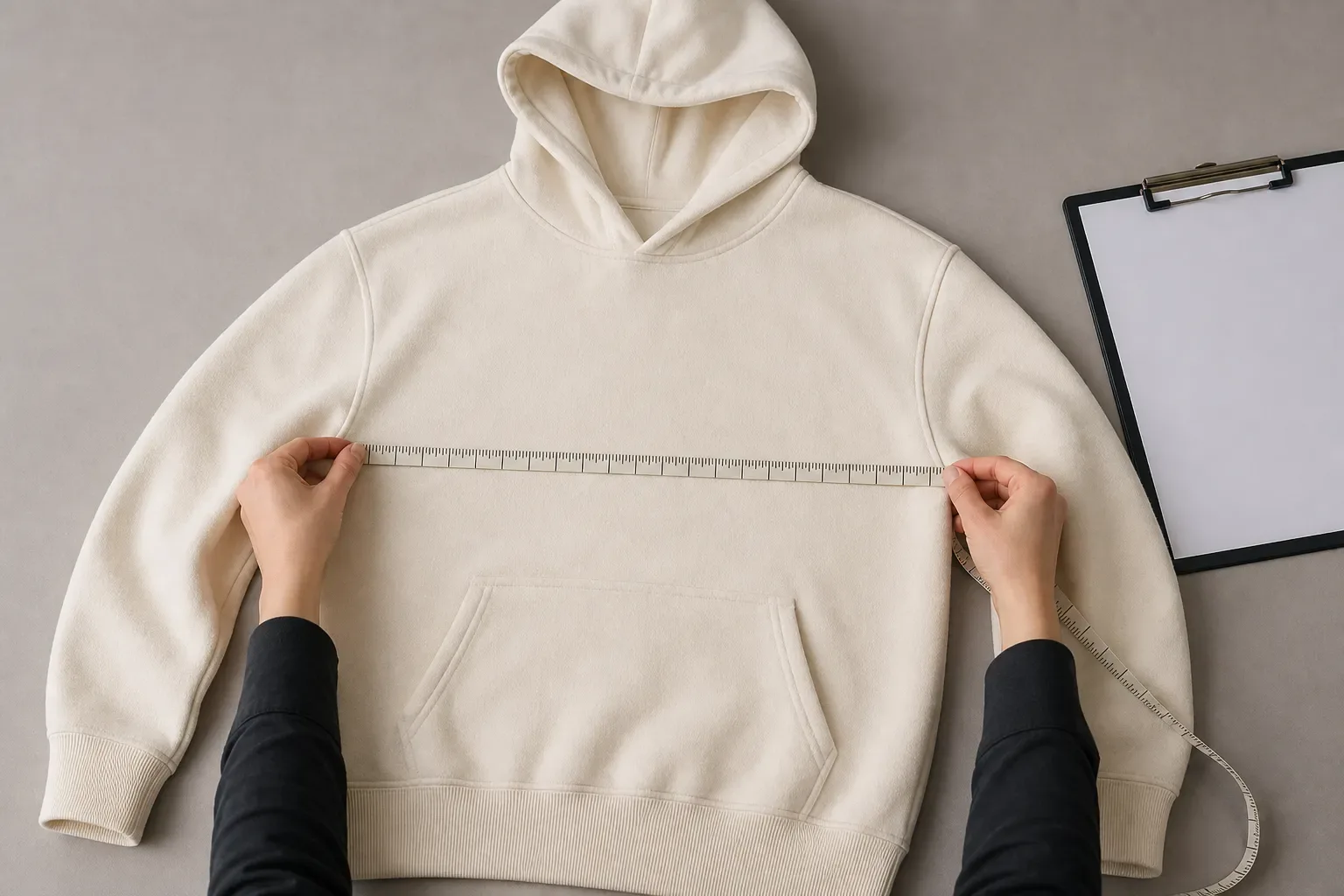
- A measurement chart by size, with tolerances. Chest, body length, shoulder, sleeve, and hem for every size, plus the allowed deviation each way. State whether measurements describe the garment before or after wash — on washed styles, that single line prevents the most common fit dispute in the business.
- A bill of materials. Fabric composition, weight, and knit for the body; ribbing; drawcords, eyelets, zips; labels and hangtags. Every physical thing in the garment, named.
- Construction callouts. Stitch and seam choices where they matter: collar, shoulder, hem, cuffs. If you don't know the technical names, close-up photos of a reference garment's seams work — "clone this construction" is a legitimate spec.
- A decoration placement map. Location, dimensions, and method for every print and embroidery. "Chest logo, embroidered, 10 cm wide, centered 7 cm below the collar seam" is quotable; "logo on chest" is a question.
- Colorways and quantities per color. These drive fabric purchasing, so they drive the price.
- Labels and packing. What the neck label says, where care information lives, and how each piece is folded and bagged.
If you have the vision but not the pattern, that's a normal starting point rather than a blocker — pattern and fit development is the factory service that turns a reference garment and measurement targets into a production pattern. And if AI drafted your first spec skeleton, our AI tech pack guide covers which lines to trust and which to verify; tell the factory which numbers you decided and which the model filled in, and the design review will flag anything that doesn't add up.
Step 6: approach factories like it's your tenth order
A factory reads an inquiry the way you'd read a job application: the signal shows in minutes. What earns a fast, serious quote is completeness — a reference (garment or clear photos), the fabric direction, quantities per style and color, and decoration details, ideally packed into a tech pack. What slows everything down: "somewhere between 50 and 500 depending on price" quantities, adjective-only fabric specs, and artwork saved as screenshots. None of those get an inquiry rejected; they get it a round of questions, and the quote follows once the gaps close.
It also helps to understand why factories decline small-brand inquiries, because it's rarely the order size itself. The common reasons are structural: quantities spread across too many styles to reach any minimum, specs too vague to price without guessing, or timelines that leave no room for sampling. Fix those three and a 50-piece program is genuinely workable — we work with startup brands as a matter of course, and the first orders that go smoothly are the complete ones, not the big ones.
Vet in both directions. How to vet a clothing manufacturer separates legal entity, operating facility, order capability, production route, and beneficiary authority before payment. Separately, look for a real design review before quoting, a sampling step before bulk, an explicit QC standard, and a communication cadence you could live with for two months. Ask what happens when something goes wrong — tolerances and remedies discussed before the purchase order tell you more about a factory than any tour video. Geography belongs in the decision too: China versus Pakistan for streetwear manufacturing breaks down the tradeoff between cost and process range — washes, heavy fleece, decoration variety — that defines the choice for most streetwear programs.
For calibration on our side of the table: our team has designed and produced garments since 2015, our main facility covers 3,000 m² in Humen, Dongguan, and how to get a quote from us documents exactly what our design review needs before a formal quotation comes back.
Step 7: sample, approve, and hold production to the sample
The sample is where your brand becomes physical, and it deserves adult attention. Check it against the tech pack line by line: measurements on the table, fabric weight, wash shade, print placement and durability, every trim. The full checklist exists because excitement is the enemy of inspection — the natural instinct is to photograph the sample for Instagram, and the necessary instinct is to measure it.
The sampling ladder: proto, fit, pre-production
Sampling is a ladder, not a single rung: a proto sample proves the design and construction, a fit sample locks the measurements, and a pre-production sample is made in the actual fabric, trims, and decoration — the one bulk gets measured against. Small programs often compress the ladder into one or two rounds, but the sequence of questions never changes: does it work, does it fit, is this exactly what production will make? A simple round typically takes 10-18 working days with us after its inputs and scope are confirmed; complex styles or processes take longer, and your evaluation time is separate.
What fails on round one is remarkably consistent across first-time programs: fit (drop-shoulder and boxy patterns read differently on a body than on paper), wash shade (the reference photo was shot in daylight; the shade you agree to should be a physical swatch, not a screen), and hand-feel (a weight chosen from a spec sheet lands differently in the hand). None of these are disasters. All of them are why sampling exists.
Most programs take one revision round. Budget for it in time (another sampling cycle) and money (a revised sample is a new sample). A first-time founder who approves a flawed sample to save two weeks buys fifty flawed garments; the revision is always cheaper than the regret. If you're unsure which of the sample types you're looking at — proto, fit sample, pre-production — the guide maps them.
Production, and the QC you can run from your desk
After approval, bulk runs 20-30 working days: fabric in, cutting, sewing, wash and finish, decoration, and a finished-garment check on every piece before packing. Your leverage as a small brand is clarity, not volume. An approved sample plus a complete tech pack gives the factory an unambiguous target, and gives you an unambiguous standard to hold the delivery against. If you want to go deeper on inspection standards, AQL sampling is the industry's shared language.
AQL, in plain English, is a statistical inspection standard: instead of checking every piece or trusting luck, an agreed number of finished garments are pulled at random, and the batch passes or fails based on how many defects of each severity turn up. AQL 2.5 is a common level for apparel. You don't need to run the inspection yourself to benefit from it — you need the standard named in your purchase order. The other clauses worth writing down before bulk starts: the approved sample as the binding quality reference, the measurement tolerance table, the packing spec, and label placement. On our floor, finished-garment QC and packing is a checked step on every piece before cartons close, and asking any factory to describe that step in its own words is a fair vetting question.
Ask for pre-shipment photos or video against your checklist. It's a small request that catches the expensive category of surprise: the kind discovered after freight is paid.
The honest timeline, week by week
From first sketch to garments in hand, a first custom program realistically spans 12-20 weeks. The middle of that range looks like this:
- Weeks 1-3: design and spec. References chosen, styles designed, tech packs written.
- Weeks 3-4: quoting. Inquiries out, design reviews, quotes back, factory chosen.
- Weeks 4-6: simple sampling round one. Typically 10-18 working days after the required inputs and scope are confirmed; complex styles or processes take longer.
- Weeks 6-8: revision and approval. One revision round for many programs, plus your evaluation time.
- Weeks 8-14: bulk production. Typically 20-30 working days after sample approval.
- Weeks 14-15 and beyond: freight. Express adds days; sea adds weeks.
The full sample-to-bulk timeline breaks these stages down further. Two planning notes from experience: fabric availability can add time before sampling even starts, since custom-dyed or unusual fabric has its own lead time; and if your window crosses late January into February, plan around Chinese New Year — factories close, and the queue on both sides of the holiday is real. Launches compress badly, so pick the launch date last, not first.
Budget the first run with real numbers
At Jiashun's published tiers, a 50-piece single-style first run costs roughly USD 900-2,300 depending on garment type. The line items, from our own catalog at made-to-order quantities — each row priced at the top of its published range:
| Style | Published per-piece tiers | First run of 50, approx. |
|---|---|---|
| Heavyweight boxy tee | USD 13.60-17.60 | ≈ USD 880 |
| Washed heavyweight hoodie | USD 27.60-31.90 | ≈ USD 1,600 |
| Acid wash baggy jeans | USD 26.80-30.90 | ≈ USD 1,550 |
| Quilted vintage-wash jacket | USD 42.90-45.90 | ≈ USD 2,300 |
Add a project-specific quoted amount per sample, your freight, and your launch costs — content, packaging, ads — which are yours to size. A focused two-style capsule (tee plus hoodie) is realistically a USD 2,500-3,000 production budget before freight and marketing. The per-piece price drops a few dollars as quantities step toward a few hundred; the full MOQ economics explain why minimums exist at all and where the tiers flatten.
Rather than third-party "cost to start a brand" figures — which never survive contact with a real spec — it's more useful to know the five drivers that move every quote we issue:
- Fabric weight. The largest cost component in most cut-and-sew garments, and fabric is bought by weight. A 300 GSM tee simply contains more cotton than a 200 GSM tee.
- Construction complexity. A tee is a handful of panels; a quilted jacket is dozens, plus lining, zips, and pocket bags. Labor scales with seams and operations, not with how simple the sketch looked.
- Decoration count. Every placement adds a setup, a labor line, and an inspection surface. One four-color back print costs more than one one-color chest hit, and three placements cost more than either.
- Order size. Setups amortize across pieces, which is why per-piece prices fall as quantities climb and why the tiers flatten toward a few hundred units.
- Freight. Air is billed by weight, so heavy garments compound the fabric decision; sea is cheaper per piece but adds weeks.
For line-by-line breakdowns of where the money goes inside a single garment, the tee production cost guide and hoodie production cost guide itemize it.
The uncomfortable, useful framing: if 50 pieces feels like too much inventory, that's not a production problem — it's the demand question, and it's better answered before production than after.
Freight, landed cost and the price on the tag
The garments still have to reach you. Express freight for a 50-piece run is fast and simple; sea freight only starts making sense at real volume. Quotes come as Incoterms — EXW, FOB, DDP — and the difference between them is who pays and who's responsible at each leg. Build landed cost per piece (production + freight + any duties) before setting retail price, not after; a healthy streetwear margin needs landed cost, not factory cost, as its denominator.
The working formula: landed cost per piece = production price + sampling spread across the run + freight per piece + any duties. Set your retail from that number and your positioning, and be honest about the answer — a price that only covers factory cost is a hobby with revenue. Two practical moves for a first drop: get the freight quote before production ends, not after, so the retail price is set on real numbers; and if the margin looks thin, fix it with product decisions at drop two — weight, decoration count, order size — rather than by discounting drop one. A 50-piece drop that sells out at full price teaches you more than one that clears on markdown.
Launch: sell the drop you can actually deliver
The drop model exists because it matches exactly the constraints you have: 50-150 pieces, a fixed date, a community that knows the run is limited. Scarcity at your scale is honest, so use it straight — announce the date, show the product being made, sell through, restock the winner.
Where the demand now lives is measurable. eMarketer's December 2025 analysis put US social commerce at USD 87.02 billion for 2025, up 21.5%, and expects it to pass USD 100 billion in 2026 — with TikTok Shop alone at USD 15.82 billion in US sales in 2025. eMarketer's January 2026 forecast has TikTok Shop reaching a projected USD 23.41 billion in US sales this year, up 48%, and finds that 73% of US Gen Z name social media as their main product-discovery source. For a new streetwear brand, the practical translation: distribution is content plus community plus native checkout, not a paid-reach budget you don't have.
Here's the asset most founders don't realize they own: the production process itself is the content. Sample unboxings, measuring the sample on camera against the tech pack, wash-shade comparisons, revision decisions, bulk progress — documenting the build gives you weeks of material nobody can copy, because it's your product being made. It also educates your audience into valuing exactly what you chose to build: the weight, the wash, the construction. A founder in a print-on-demand lane has mockups; you have a factory floor's worth of proof.
The resale dynamic from earlier belongs in the launch plan too. Heavyweight construction and distinctive washes are what survive and circulate secondhand, and the secondhand rack is where a growing share of future customers first meets a label. Build pieces worth reselling and the loop works for you without a budget line.
Pre-orders deserve a final mention: at 50-piece scale, a pre-order window against an approved pre-production sample can fund bulk and answer the demand question at the same time. It only works when the timeline promise is real — which is why the week-by-week schedule comes before the launch plan, not after it.
The mistakes that kill first streetwear drops
After enough first-time programs, the failure patterns repeat:
- Skipping the tech pack because a DM thread "already explains it." The thread always disagrees with itself by sample time.
- Too many styles, too many colorways. Five styles × three colors = fifteen minimums. The math ambushes people.
- Approving the sample on vibes. Unmeasured samples become unmeasured production.
- Sizing by guesswork instead of building a real size chart from a reference garment that fits.
- Pricing from factory cost instead of landed cost, then discovering freight ate the margin.
- Shopping quotes on price alone. The cheapest quote against a vague spec isn't a price for your garment; it's a price for whatever that factory imagined. Quotes only compare when the spec is fixed.
- Announcing the launch date before sample approval. The date becomes the enemy of the revision round, and the revision round is what protects the product.
- Spending the entire budget on drop one. The most valuable thing a first drop produces is the knowledge of which style to restock. Founders with nothing left for the reorder watch the winner sell out and the momentum expire with it.
None of these are talent problems. They're process problems, and process is copyable — that's the point of this playbook.
When you're ready to price a real first drop, send your reference and quantities to sales@jiashunclothing.com or WhatsApp — with a complete spec, quotes follow once sufficient project details are reviewed.
FAQ
How much does it cost to start a streetwear brand?
On the production side, at published tier pricing: a single custom style at the 50-piece minimum runs roughly USD 900-2,300 depending on garment type, plus a project-specific quoted amount per sample. A two-style capsule is realistically USD 2,500-3,000 in production budget before freight and marketing. What moves the number is fabric weight, construction complexity, decoration count, order size, and freight — not a universal startup figure.
Can I start a streetwear brand with no money?
Not a custom-manufactured one — cut-and-sew production requires real capital for sampling and a first run. What you can do with almost no money is prove demand: print-on-demand platforms and pre-orders test whether designs sell before any inventory exists. Treat that stage as market research that funds the first real production run, not as the destination.
Do I need an LLC or a business license to start a streetwear brand?
Requirements vary by state and country, so this is a question for your local official resources rather than legal advice. Many US founders start as sole proprietors and form an LLC as revenue grows, mainly for liability separation and smoother banking. Sales tax registration and local licensing depend on where and how you sell.
Can I put my own label on wholesale blank clothing?
Only when the blank supplier's terms permit the planned decoration or relabeling and the finished garment meets the applicable rules in its sales markets. That is a decorated-blank or white-label route in this guide, not proof of made-to-order private-label production. For US covered products, use the FTC textile and care-label guidance linked above, and screen the brand name with the USPTO trademark search before printing labels.
What MOQ do clothing manufacturers require?
Minimums vary by factory and product; ours starts at 50 pieces, with the final minimum depending on the product, fabric, wash, and customization. That starting point exists because fabric, setups and line time don't subdivide well below it — and it is also an honest demand test for a first production run.
How many designs should a first streetwear drop have?
Two or three. Every additional style multiplies sampling cost, minimums, QC surface and unsold-inventory risk, and a tight capsule that sells out builds a brand faster than a wide range that trickles. Add width in drop two, funded by drop one.
What fabric weight should streetwear use?
For tees, 200-250 GSM delivers the structured boxy look, with 250-300 GSM as premium heavyweight; most streetwear hoodies land at 380-450 GSM. Weight and silhouette are one decision — oversized patterns need heavier fabric to hold their shape. Heavier also costs more, in fabric and in freight, so choose the weight your positioning supports rather than the biggest number you've seen.
How long does it take to start a streetwear brand?
From first sketch to garments in hand, plan on 12-20 weeks: design and tech packs, quoting, a simple sample that typically takes 10-18 working days after confirmation, any revision rounds, 20-30 working days of bulk production after approval, then freight. Complex styles or processes take longer. From a finished tech pack alone, two to three months can be a useful planning range for a simple program, but the formal project schedule controls. Launches compress badly, so set the date from the schedule, not the other way around.